
Audit Overview
Your store's untapped revenue potential — and how to unlock it
Why We Created This Audit
We analyzed rspnutrition.com the same way we've audited 350+ e-commerce stores — looking for the specific gaps between your current experience and what top-performing Health & Wellness stores deliver. Every finding in this report is a revenue opportunity backed by industry data and competitive benchmarks.
What We Analyzed
- UX & Conversion Design21 findings
- Performance & Speedvs 3 competitors
- Technology & App StackPlatform + 4 apps
- Industry BenchmarksHealth & Wellness
Pages Analyzed
- Homepage2 findings
- Collection Pages2 findings
- Product Pages (PDP)15 findings
- Cart & Checkout2 findings
 This audit was prepared by Growisto — a CRO-led Website development team behind 167% conversion growth for Atomberg, 46% CR lift for TyresNmore, and 350+ e-commerce projects.
UX & Conversion Findings
Page-by-page analysis with visual comparisons against top Health & Wellness stores
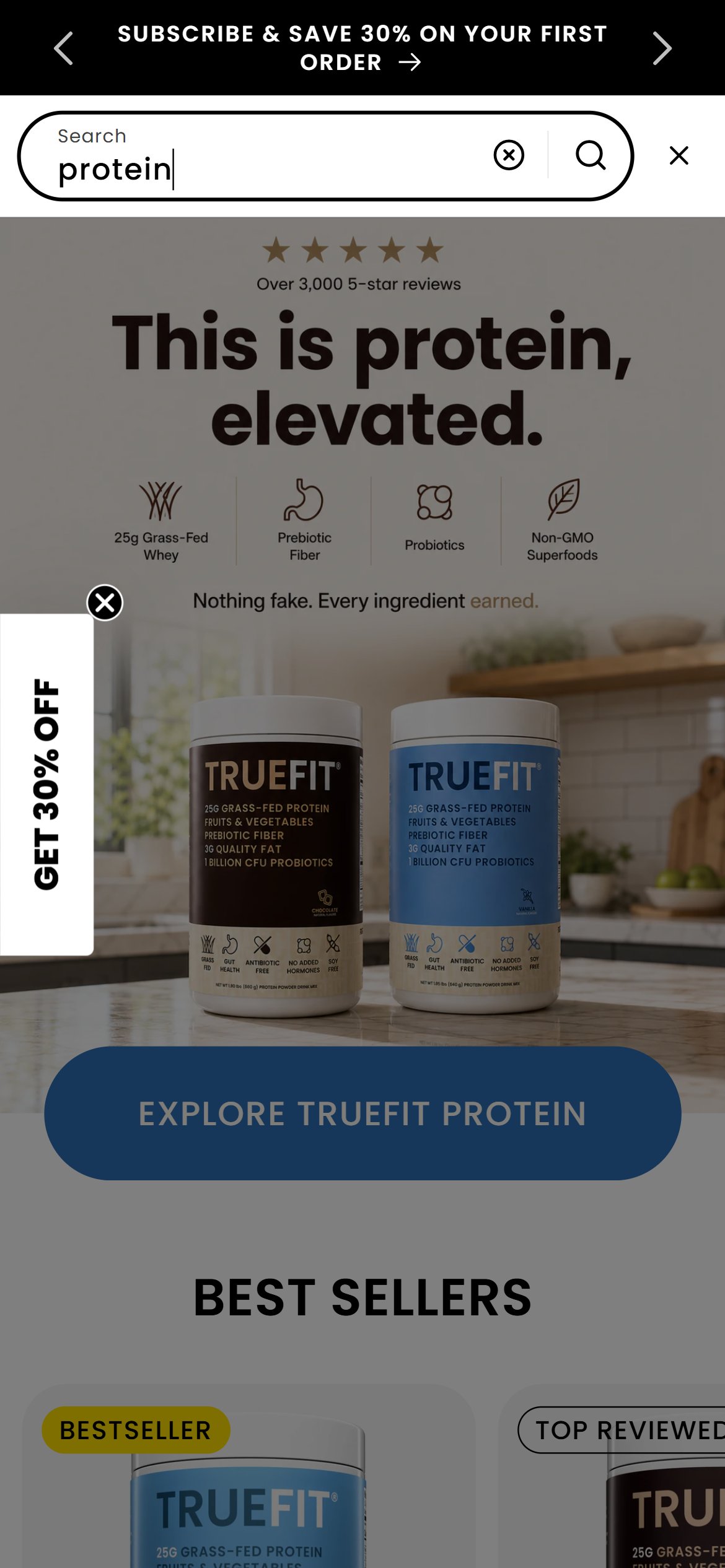
- RSP Nutrition's search requires the user to type a full query and press Enter before any results appear — no dropdown, product suggestions, or popular-search shortcuts fire while typing (confirmed by probe HP-02 and live re-verification: typing 'protein' surfaced no predictive panel).
- Supplement shoppers browse by goal or ingredient ('creatine', 'pre-workout vanilla') — without type-ahead they complete a full search-and-load cycle to find products, adding friction at intent-peak moments.
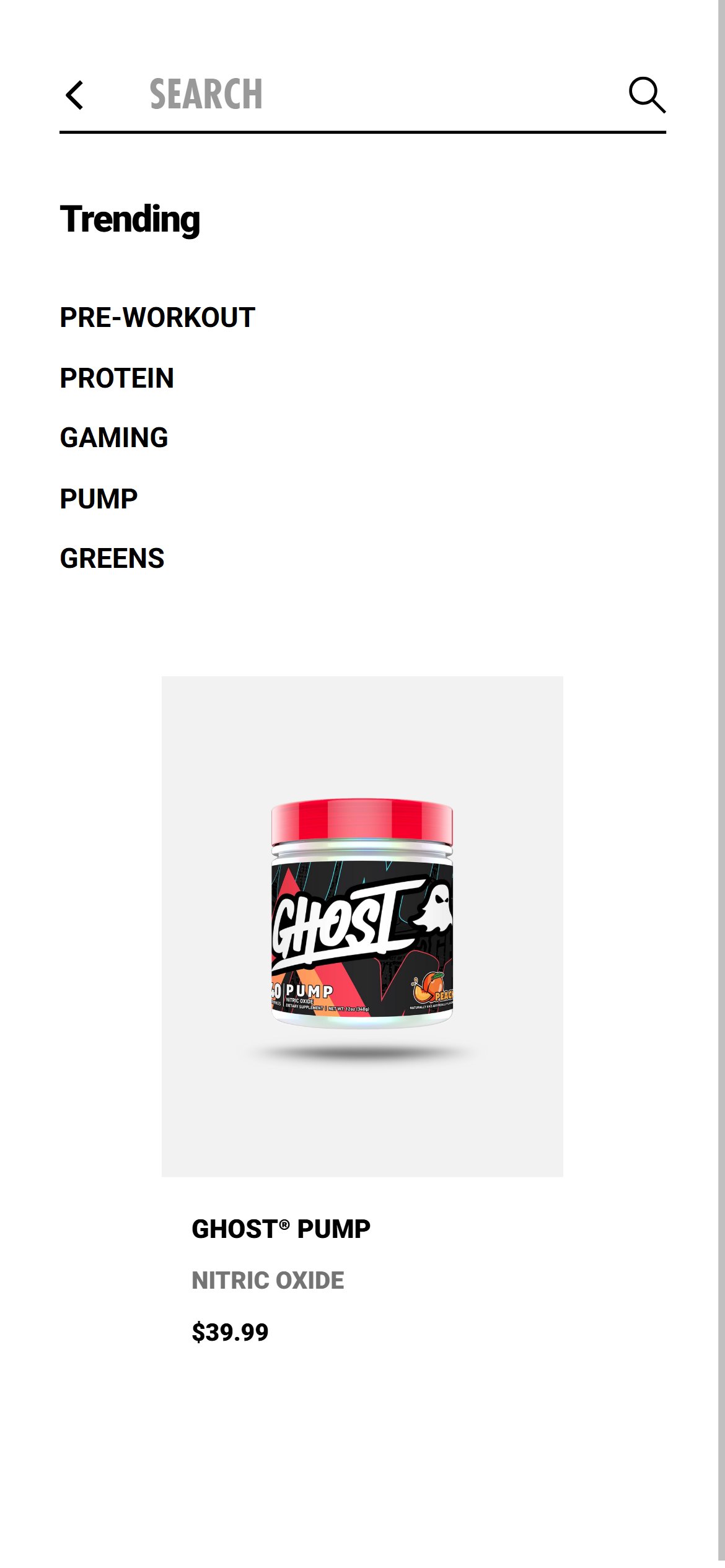
- Competitors such as Ghost Lifestyle surface product cards, trending categories, and a live result as the shopper types — guiding them to a PDP in one step instead of a search-results page.
- Predictive search is consistently one of the highest-leverage discovery upgrades: removing the extra keypress-and-load step measurably lifts the share of search sessions that reach a product page.
- Enable Shopify's native Predictive Search API (available on all plans) or a dedicated app (Searchanise, Boost Commerce, Searchie) — configure it to surface product name, flavor/variant, and category matches after 2+ characters.
- Prioritise best-selling SKUs (TrueFit Protein, AminoLean) and goal-based categories (Protein, Pre-Workout, Recovery) in the dropdown to steer first-time visitors toward high-conversion pages.
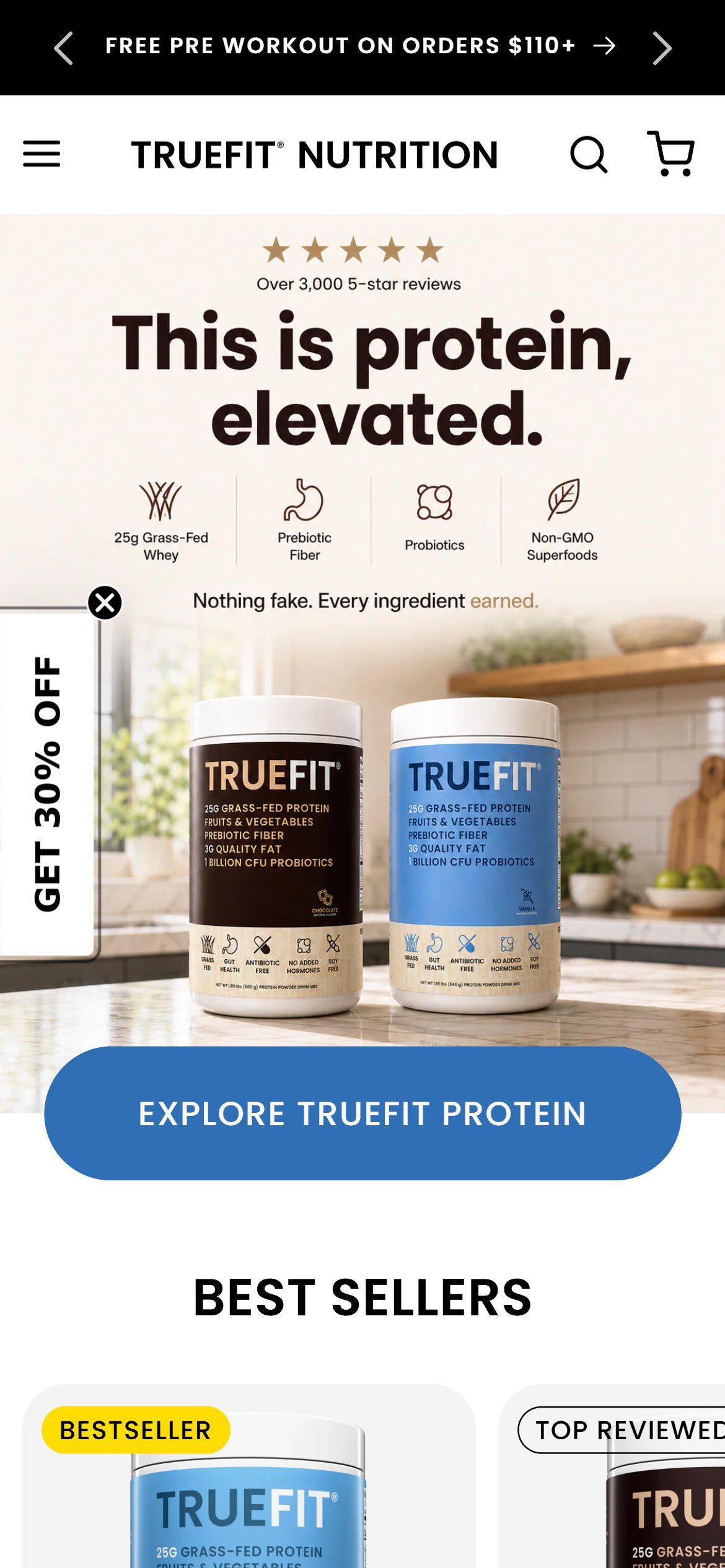
- RSP Nutrition's navigation and homepage offer no product-finder, quiz, or 'find your supplement' entry point (full nav and footer enumerated during live re-verification — no quiz CTA anywhere).
- RSP's catalog spans six distinct goals (protein, pre-workout, energy, recovery, weight management, creatine) — a first-time visitor unsure which product fits their objective must self-navigate, a known drop-off point for multi-SKU supplement brands.
- A quiz/assessment CTA is a differentiator pattern present on 4/10 top US health and wellness stores (e.g., Seed, Onnit) — those that have it report materially higher conversion on quiz-started sessions because the funnel is personalised.
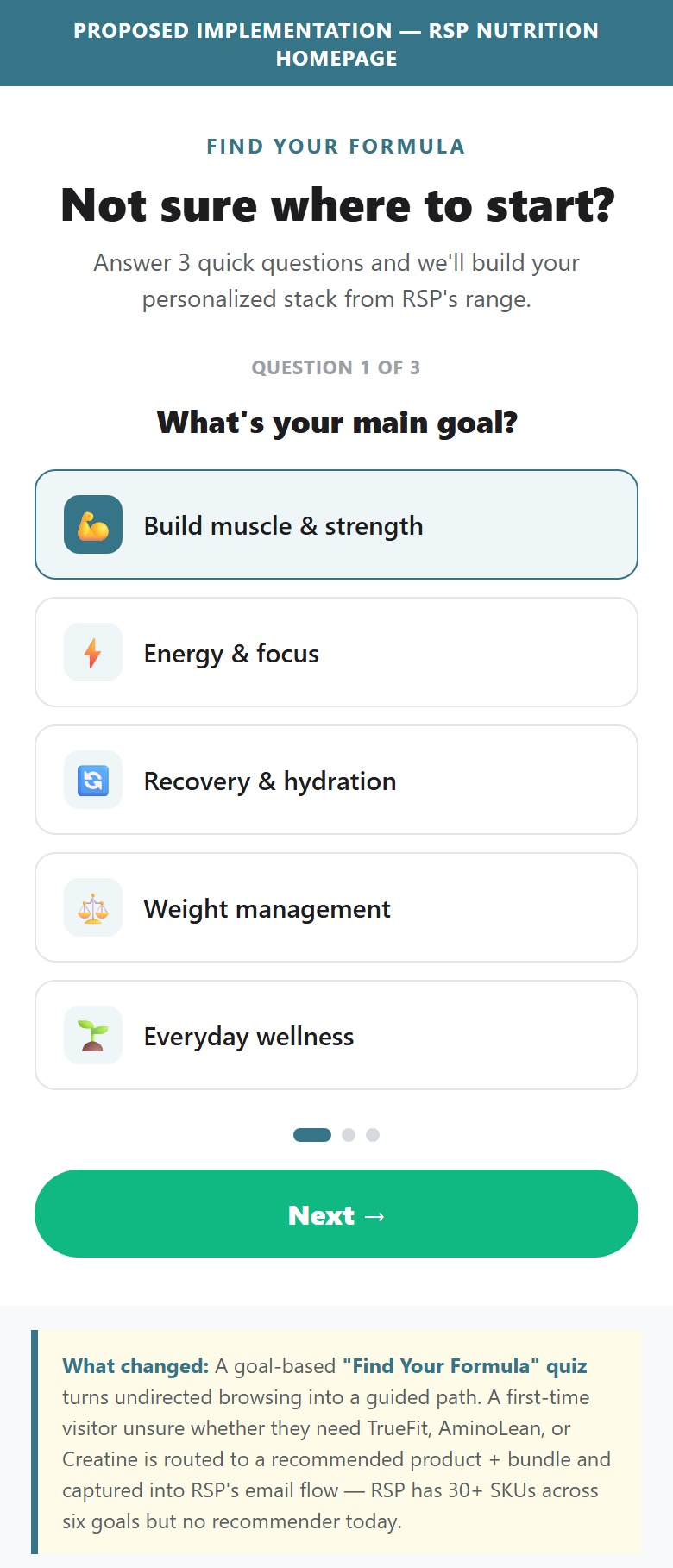
- RSP already has a Bundle Builder; pairing it with a goal quiz turns undirected browsing into a guided path that ends on a recommended product or bundle.
- Add a 'Find Your Formula' quiz (Octane AI, Rebuy Quiz, or Klaviyo Quiz) keyed to goal + training frequency + dietary preference; route the result to a recommended SKU plus a complementary bundle.
- Surface the quiz as a primary nav item and a secondary homepage-hero CTA, and capture the email at the result step to feed RSP's existing Klaviyo flows.
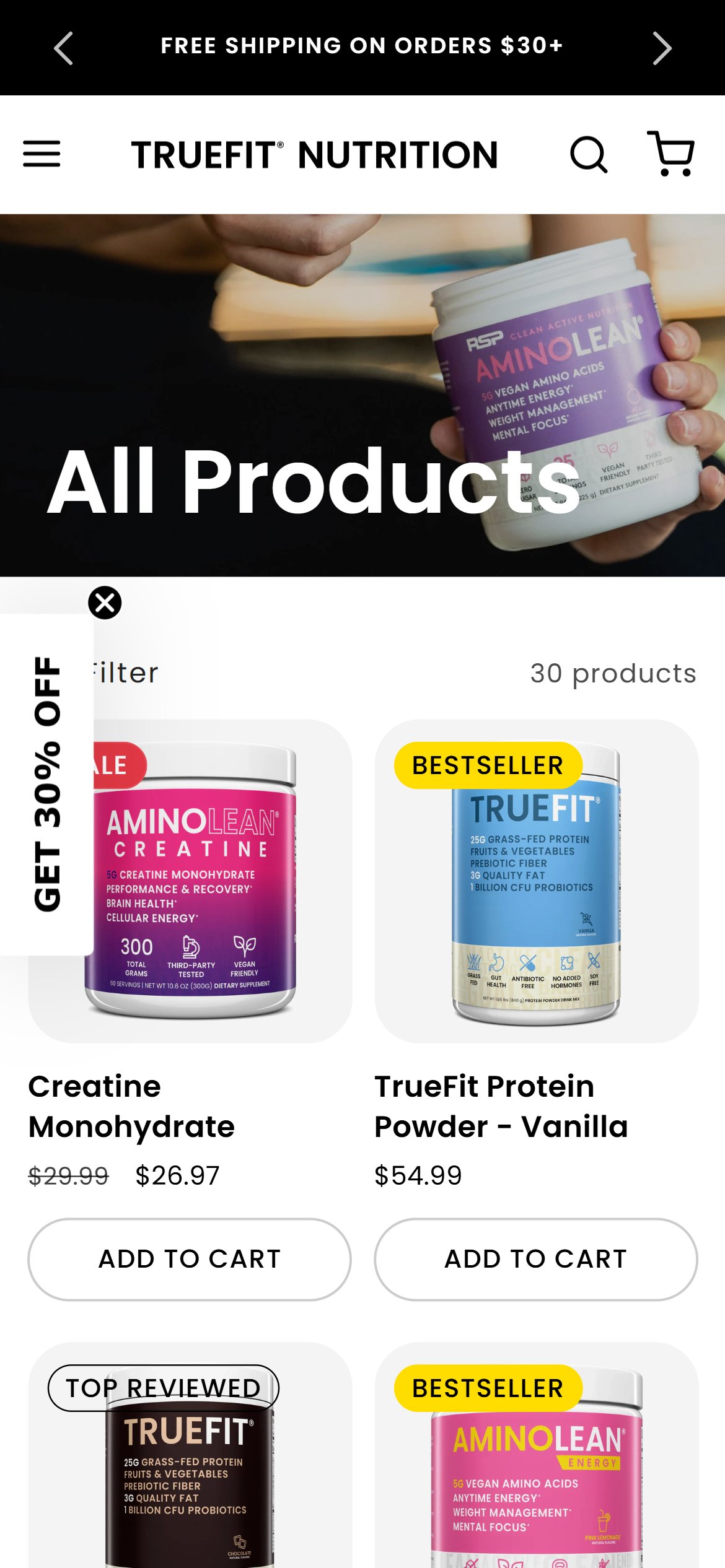
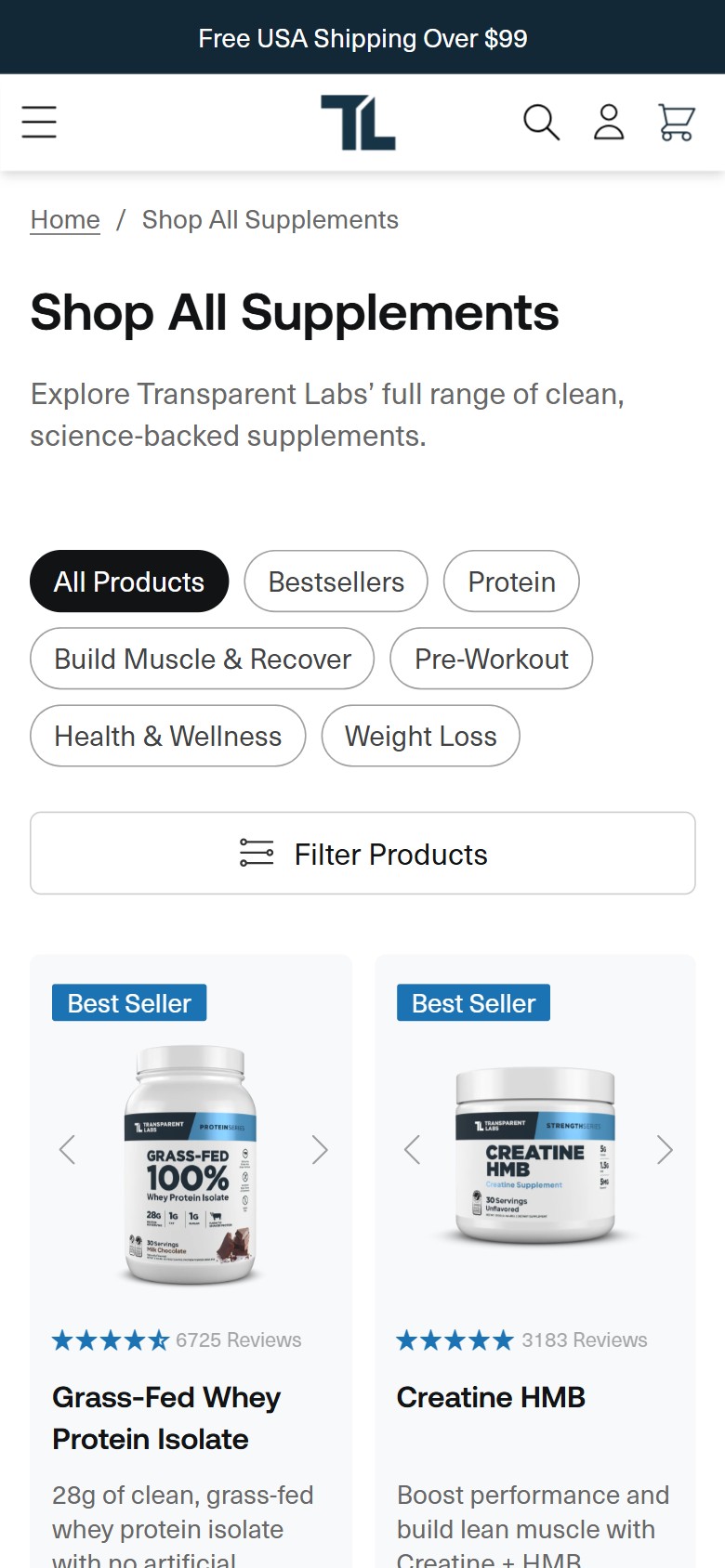
- Every product card on the Shop All collection shows only image, product name, and price — no star rating, no review count, no serving-size indicator, and no flavor/variant pill (confirmed by probe CP-05: absent).
- TrueFit Protein carries 360+ verified reviews with strong ratings on its PDP, but none of that social proof surfaces at the collection-card level — shoppers who don't click through never see it.
- Transparent Labs shows a star rating and review count on every collection card (e.g., '6,725 Reviews', '3,183 Reviews'), turning the grid itself into a trust-builder that competes directly with Amazon listings.
- Star ratings on cards are a Growing pattern across 7/10 top US health and wellness stores; flavor/serving pills additionally reduce pogo-sticking by letting shoppers screen variants before opening a PDP.
- Connect the existing Judge.me reviews app to the collection card template so the star rating + review count render on each card — typically a single theme setting or a 1-2 line snippet.
- Add flavor/variant pills and serving-size text ('1.85 lb / 20 servings') to the card via product metafields so the grid communicates key purchase-decision info without a PDP visit.
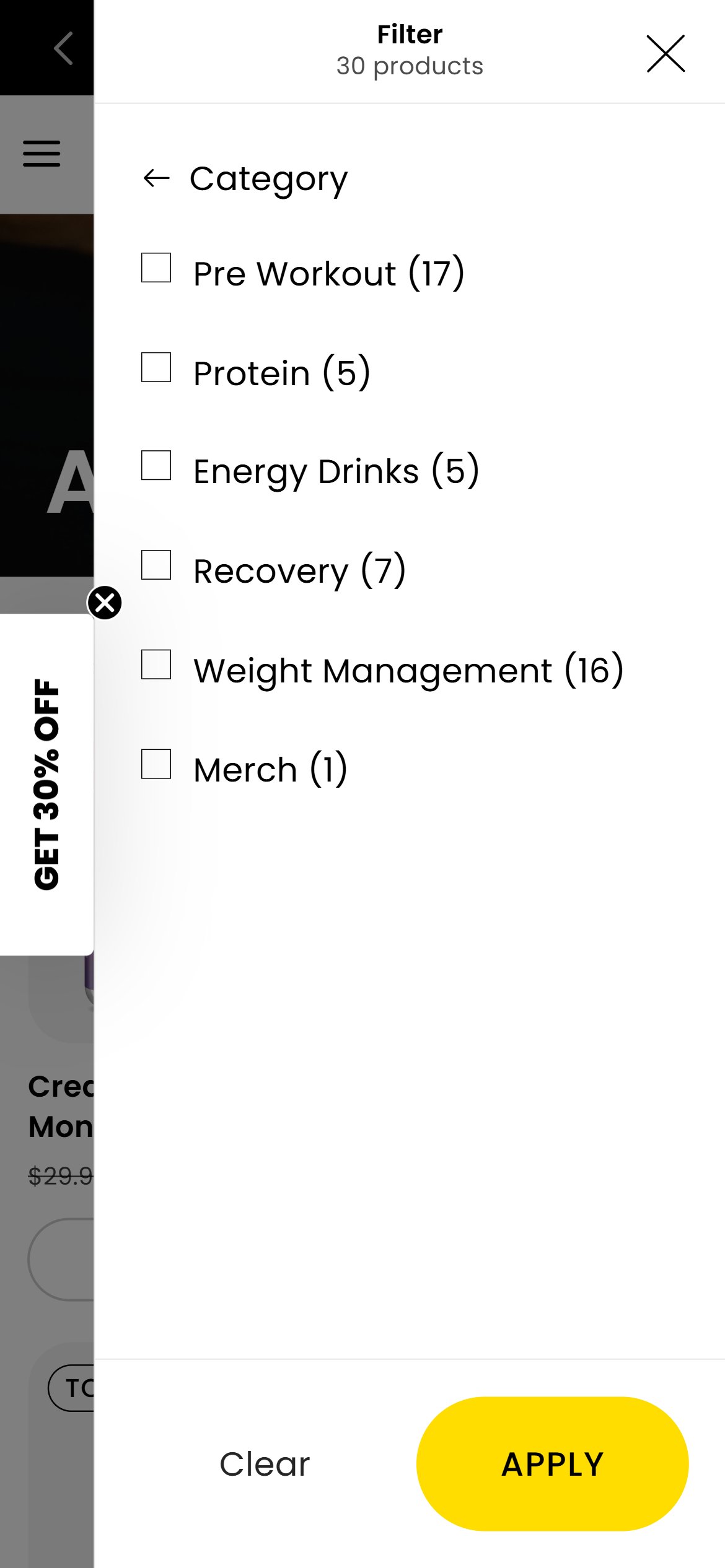
- RSP's Shop All filter panel exposes a single facet group — 'Category' with six product-type checkboxes (Pre Workout, Protein, Energy Drinks, Recovery, Weight Management, Merch) — and nothing else (confirmed by live re-verification).
- There is no price-range filter, no dietary filter (Vegan, Gluten-Free, Sugar-Free), no goal/concern facet, and no sort control — so a shopper who wants 'a vegan recovery product under $40' cannot narrow the grid at all.
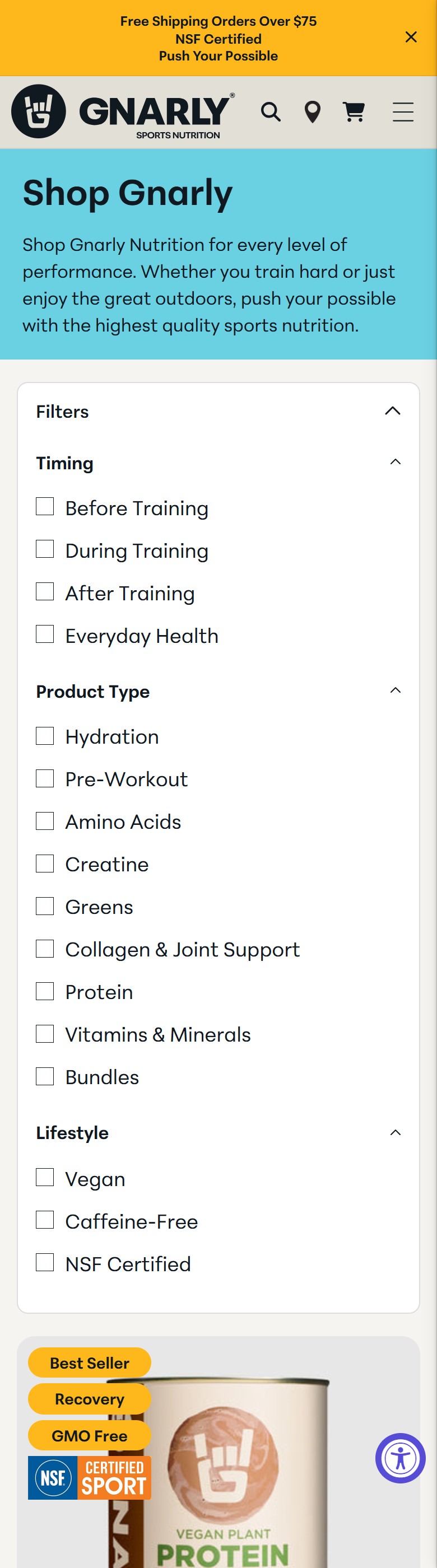
- Gnarly Nutrition's filter panel offers Timing (Before / During / After Training, Everyday Health), Product Type (nine options), and Lifestyle (Vegan, Caffeine-Free, NSF Certified) facets — aligning discovery with how supplement shoppers think about their goals.
- Goal/concern-based filtering is a Growing pattern; its absence forces shoppers arriving from paid search or social with a specific intent to scroll the whole catalog or leave.
- Expose a price-range filter and dietary facets (Vegan, Gluten-Free, Sugar-Free) using Shopify's native Search & Discovery filters — no extra app required.
- Create 'Goal' metafields (Muscle Building, Energy, Recovery, Weight Management) and surface them as filter facets, plus add a Sort control (Best Selling, Price, Newest) — these become the most-used controls for supplement shoppers and directly reduce bounce from ad landing pages.
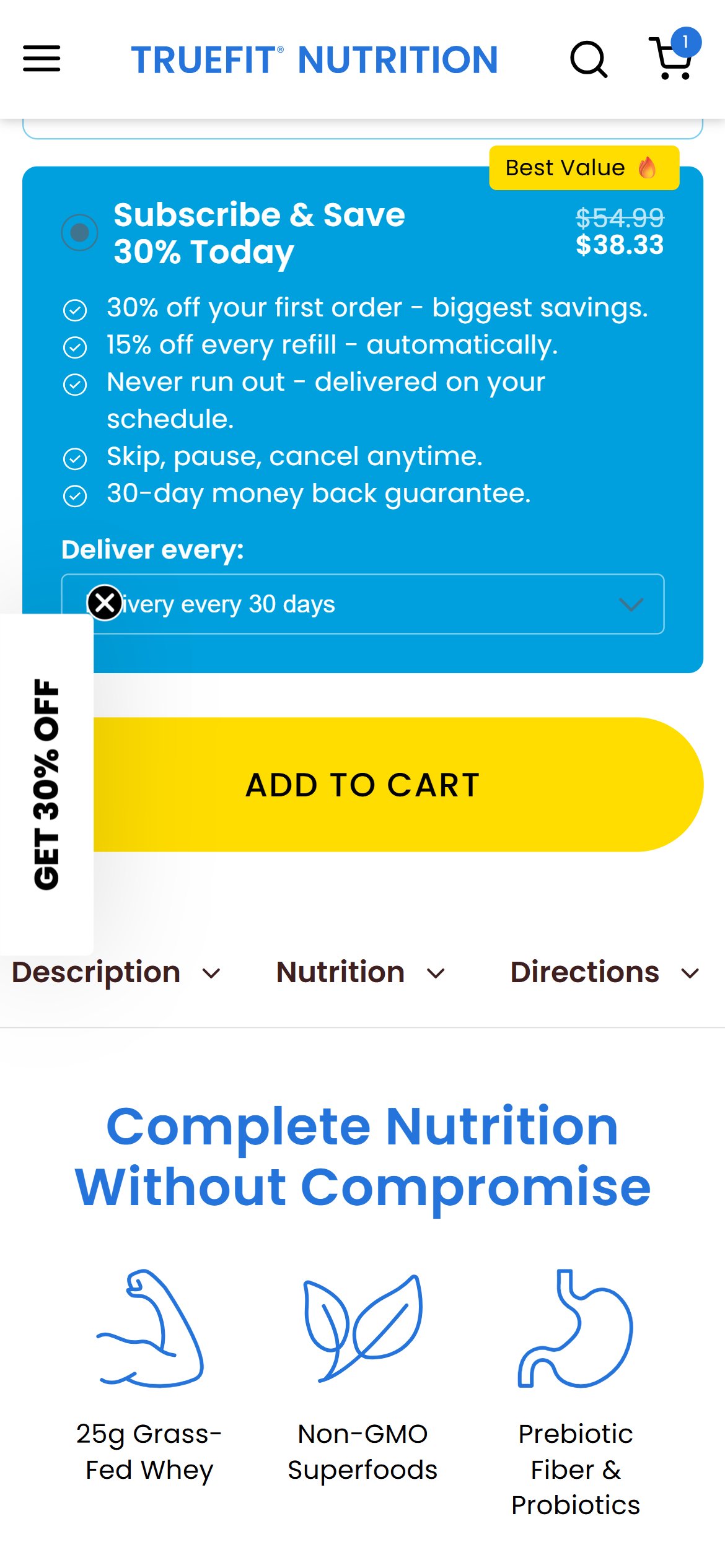
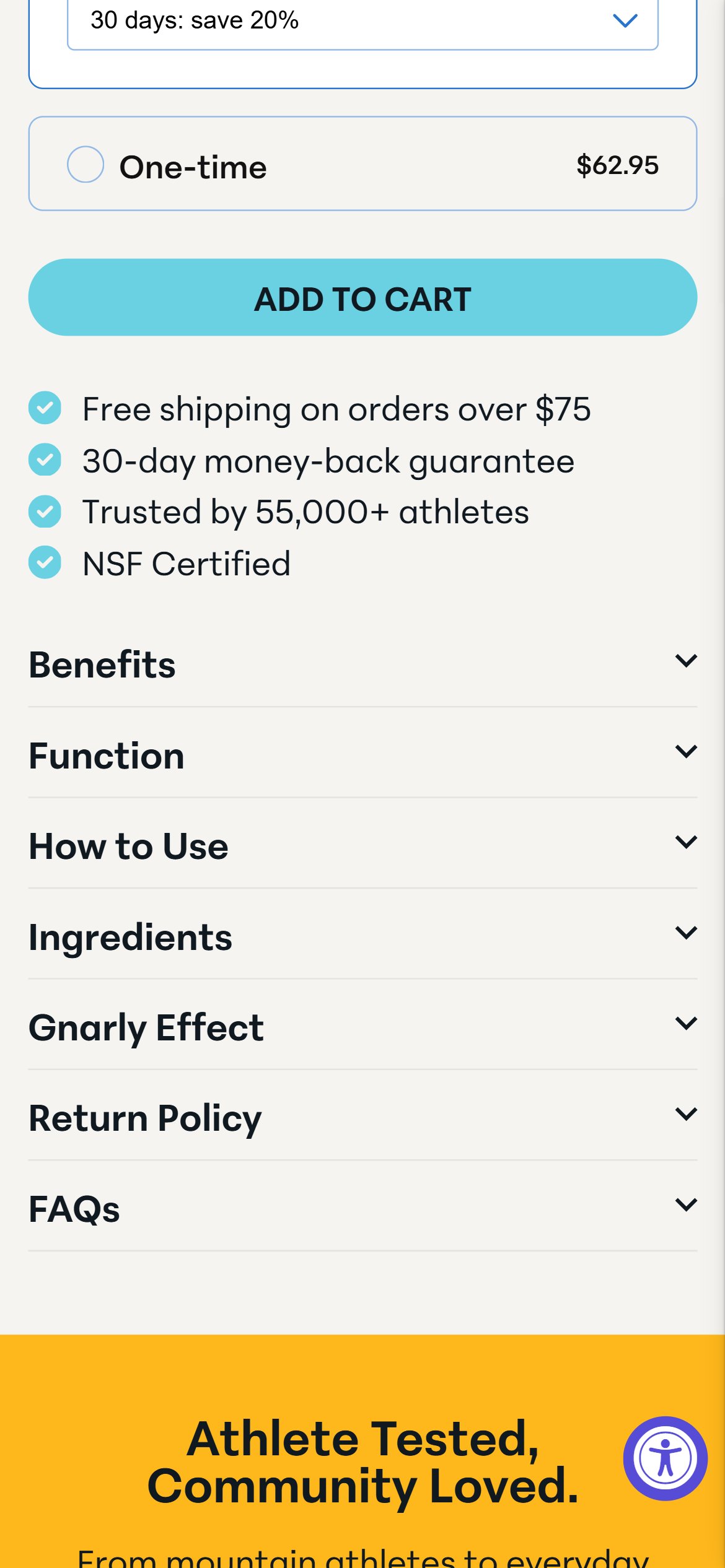
- The TrueFit Protein ATC zone shows the price, Subscribe & Save box (with a '30-day money-back guarantee'), flavor/size selectors, and the Add to Cart button — but no independent third-party certification seal (NSF Certified for Sport, Informed Sport, GMP, Non-GMO Project Verified) appears near the buy button (confirmed by live re-verification).
- Benefit claims (Grass-Fed, Non-GMO Superfoods, Prebiotic Fiber) are printed on the product pack image — these are brand marketing, not the independent, verifiable seals ingredient-conscious supplement buyers look for at the decision point.
- Gnarly Nutrition displays an 'NSF Certified' badge in a trust row directly beneath its ADD TO CART button, alongside a money-back guarantee and an athlete-trust stat — a scannable proof cluster in the purchase zone.
- Certification badges on the PDP are a Standard pattern across 8/10 top US health and wellness stores; for supplements, third-party testing proof is a primary purchase motivator and a frequent comparison point against Amazon and certified rivals.
- If RSP holds any third-party certification (NSF, Informed Sport, GMP, Non-GMO Project), display the actual seal as a small badge immediately below the ATC button — independent seals carry far more weight than on-pack marketing icons.
- If certifications are not yet held, add a 'Third-Party Tested' badge linked to a Certificate of Analysis / lab report as an interim trust layer, and prioritise pursuing NSF / Informed-Sport certification given RSP's sports-nutrition positioning.
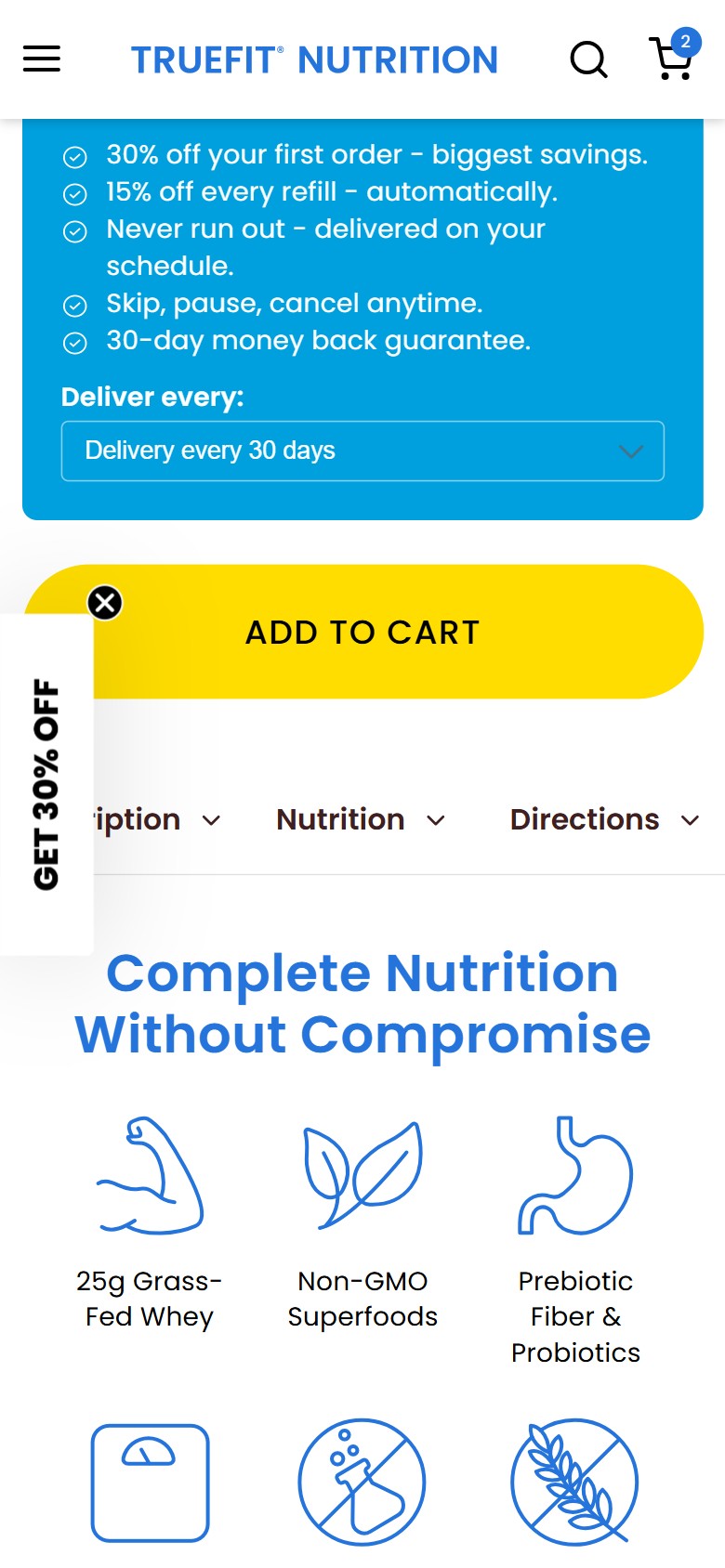
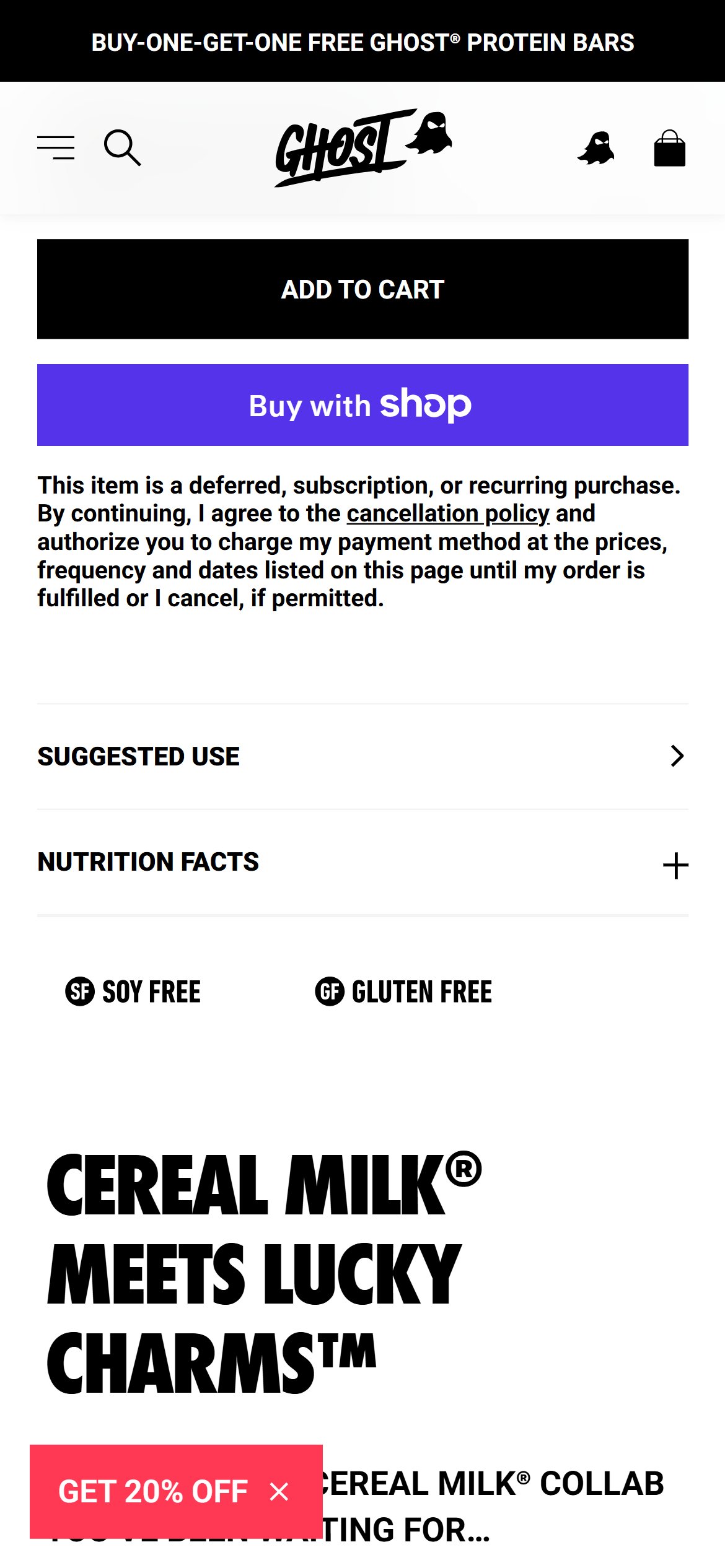
- The TrueFit Protein PDP shows only an 'ADD TO CART' button — no 'Buy Now', Shop Pay, or dynamic express-checkout button is present (confirmed by probe PDP-06 and live re-verification: no shopify-payment-button on the PDP).
- High-intent and returning customers (e.g., subscribers re-ordering TrueFit) are forced through the full cart-to-checkout flow even when they have already decided to buy — each extra mobile step adds measurable drop-off.
- RSP already runs Shop Pay, PayPal, and Google Pay in the cart, so surfacing the Shopify dynamic checkout button on the PDP is a theme-setting change, not new development.
- Ghost Lifestyle shows a 'Buy with Shop' express button directly beneath ADD TO CART on its PDP — a one-tap path especially valuable for subscription-driven reordering.
- Enable Shopify's dynamic checkout button on the PDP by adding the `payment_button` Liquid filter to the product form — it auto-renders Shop Pay / PayPal / Google Pay / Apple Pay from the shopper's saved wallet with no app install.
- Place the express button below (not replacing) ADD TO CART with an 'or' divider — preserving the standard ATC flow for new visitors while giving returning customers a faster path.
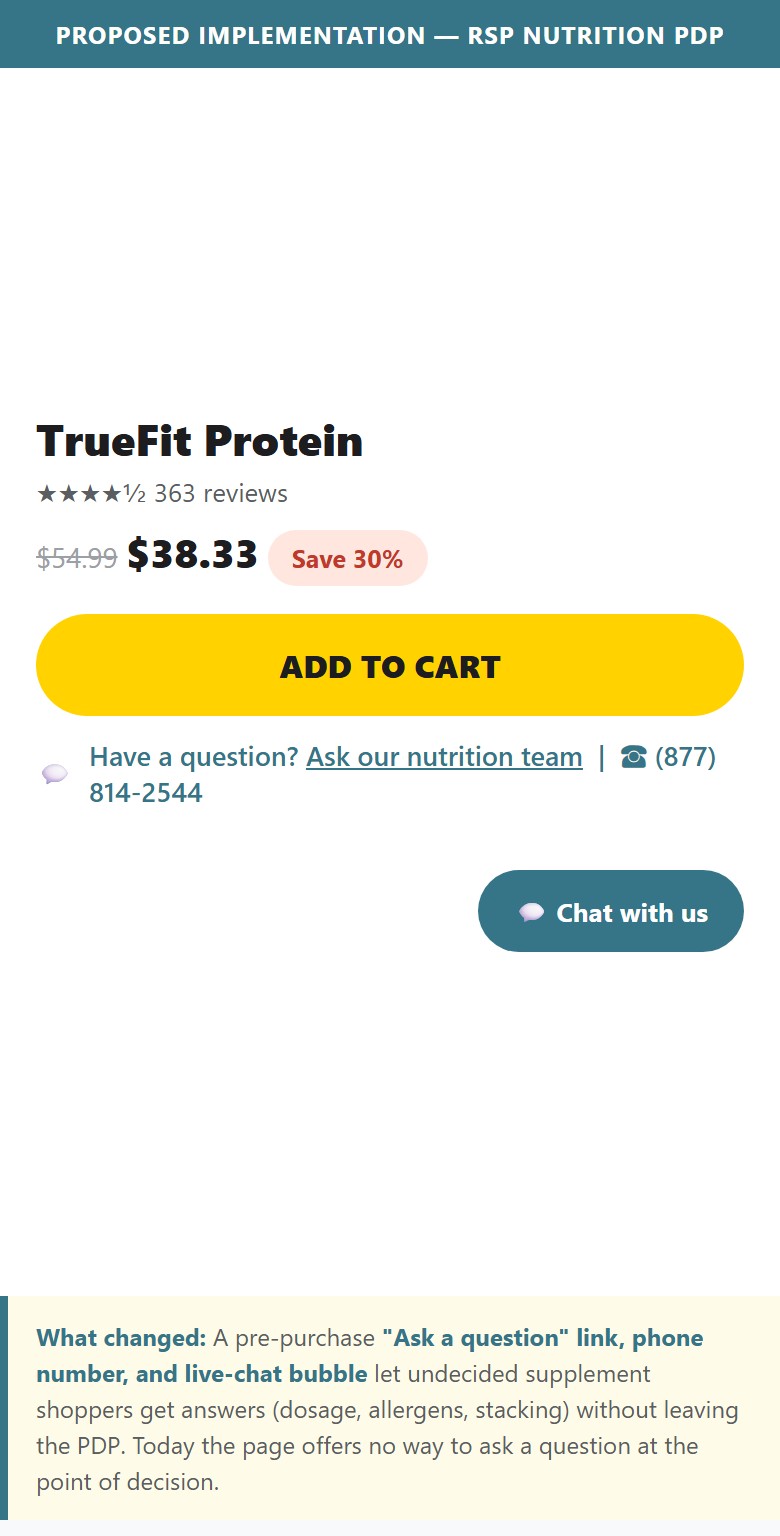
- The TrueFit Protein PDP offers no pre-purchase help mechanism — no live-chat widget, no 'Ask a question' link, and no phone number in the product content (confirmed by live re-verification: 0 chat widgets in the page DOM; the phone/email exist only site-wide in the footer).
- Supplements prompt specific pre-purchase questions — allergens, dosage, stacking with other products, suitability — that, left unanswered at the PDP, push the shopper to leave and research elsewhere.
- A visible 'ask us' affordance in the buy zone converts a moment of doubt into a conversation instead of an exit, and seeds support content (FAQs) for future shoppers.
- This is a standard trust/assistance pattern on high-converting supplement PDPs and is low-effort to add given RSP already publishes a support phone line.
- Add a lightweight live-chat / FAQ widget (e.g., Gorgias, Tidio, or a Klaviyo-connected chat) and an 'Ask a question' link near the ATC that opens it.
- Surface RSP's existing phone number (877.814.2544) and an email/chat option in the PDP buy zone, not just the footer.
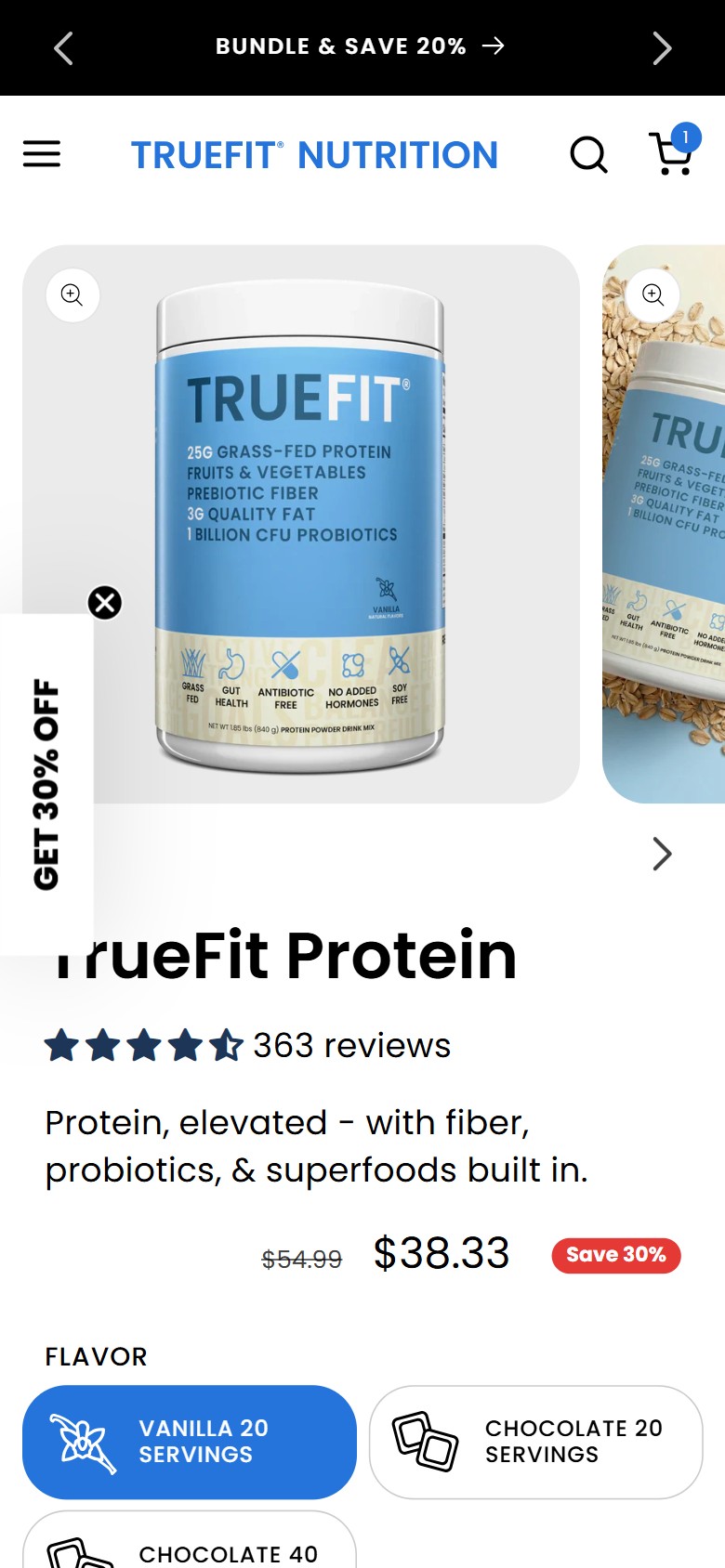
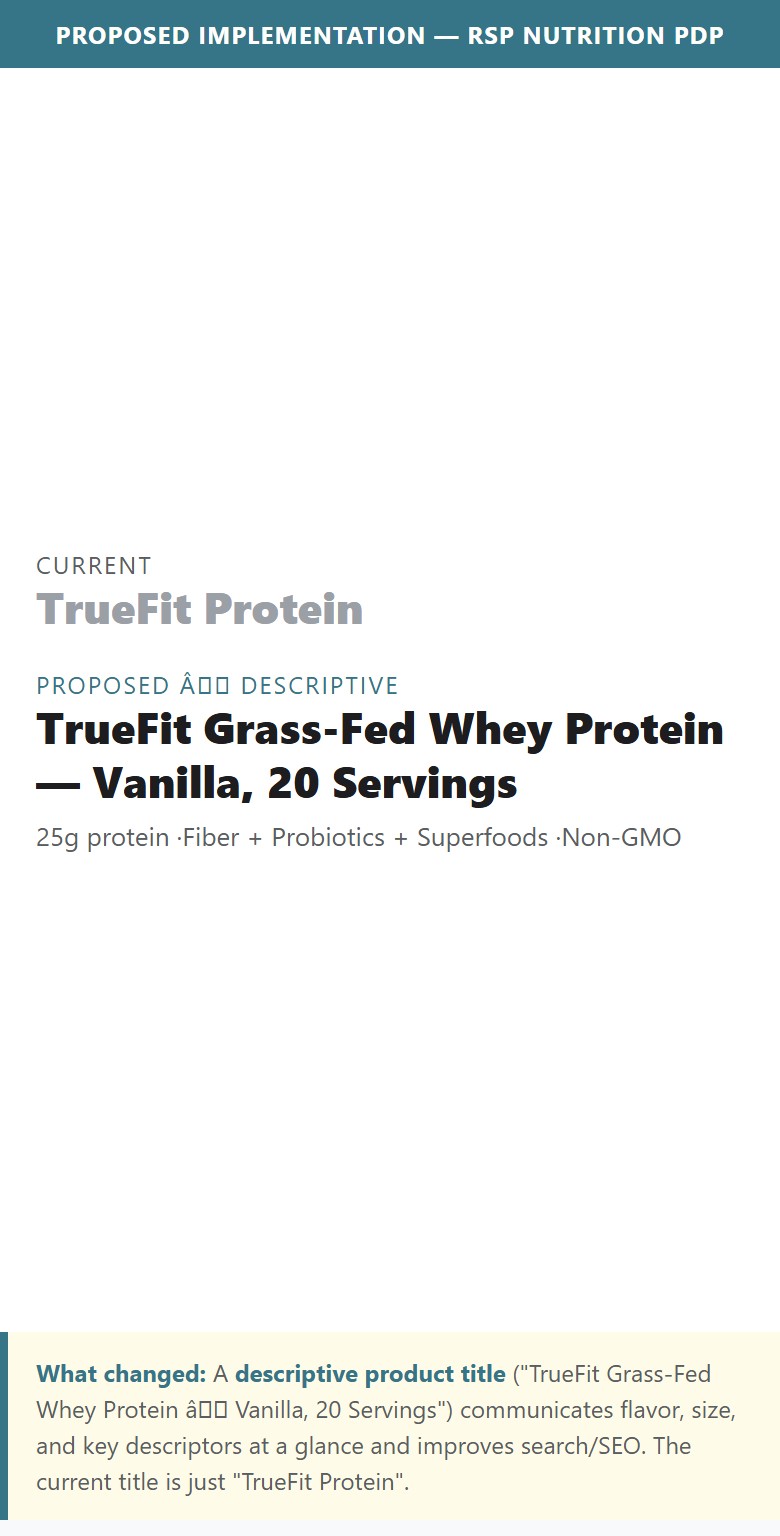
- The PDP H1 is simply 'TrueFit Protein' — it does not include the flavor, size/servings, or a key descriptor; a one-line tagline sits below it (confirmed by live re-verification).
- A non-descriptive title forces shoppers to hunt for basics (which flavor? how many servings? what kind of protein?) and weakens organic search relevance for queries like 'grass-fed whey vanilla'.
- Descriptive titles (brand + product + key descriptor + variant + size) are the norm on high-performing supplement PDPs and on the marketplaces RSP competes with.
- Because the same title is reused on collection cards, search results, and shopping feeds, the impact compounds across every discovery surface.
- Restructure the title to 'TrueFit Grass-Fed Whey Protein — Vanilla, 20 Servings' (brand + descriptor + flavor + size), keeping the tagline as a subhead.
- Apply the same descriptive title pattern across the catalog so collection cards, search, and Google Shopping feeds all benefit.
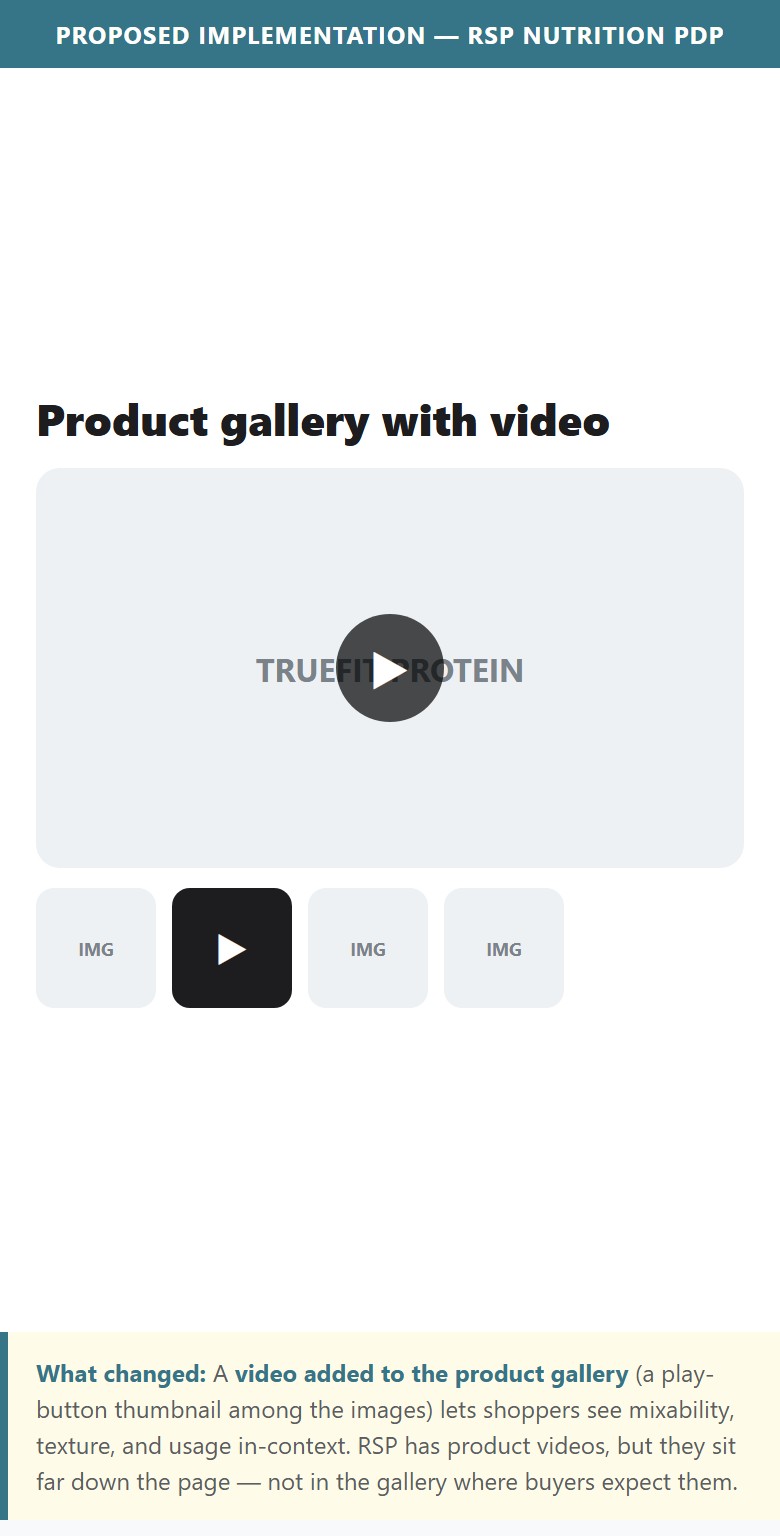
- The TrueFit Protein gallery is 10 slides, all still images — there is no video thumbnail or play button in the gallery (confirmed by live re-verification).
- RSP does have product videos, but they live in a separate content block far down the page (~4,400px down) where most mobile shoppers never reach — disconnected from the buying decision.
- For supplements, a short gallery video answers the questions photos can't (how does it mix? how thick? how big is a scoop?), reducing uncertainty and return risk.
- Video in the gallery is a Growing PDP pattern and is well supported by Shopify's native media gallery (no app required).
- Add at least one short video as a gallery slide (mixing demo / texture / 'what's inside') using Shopify's native product media — surface it as the 2nd thumbnail with a play icon.
- Reuse RSP's existing product videos by promoting them into the gallery rather than leaving them in a low-scroll content section.
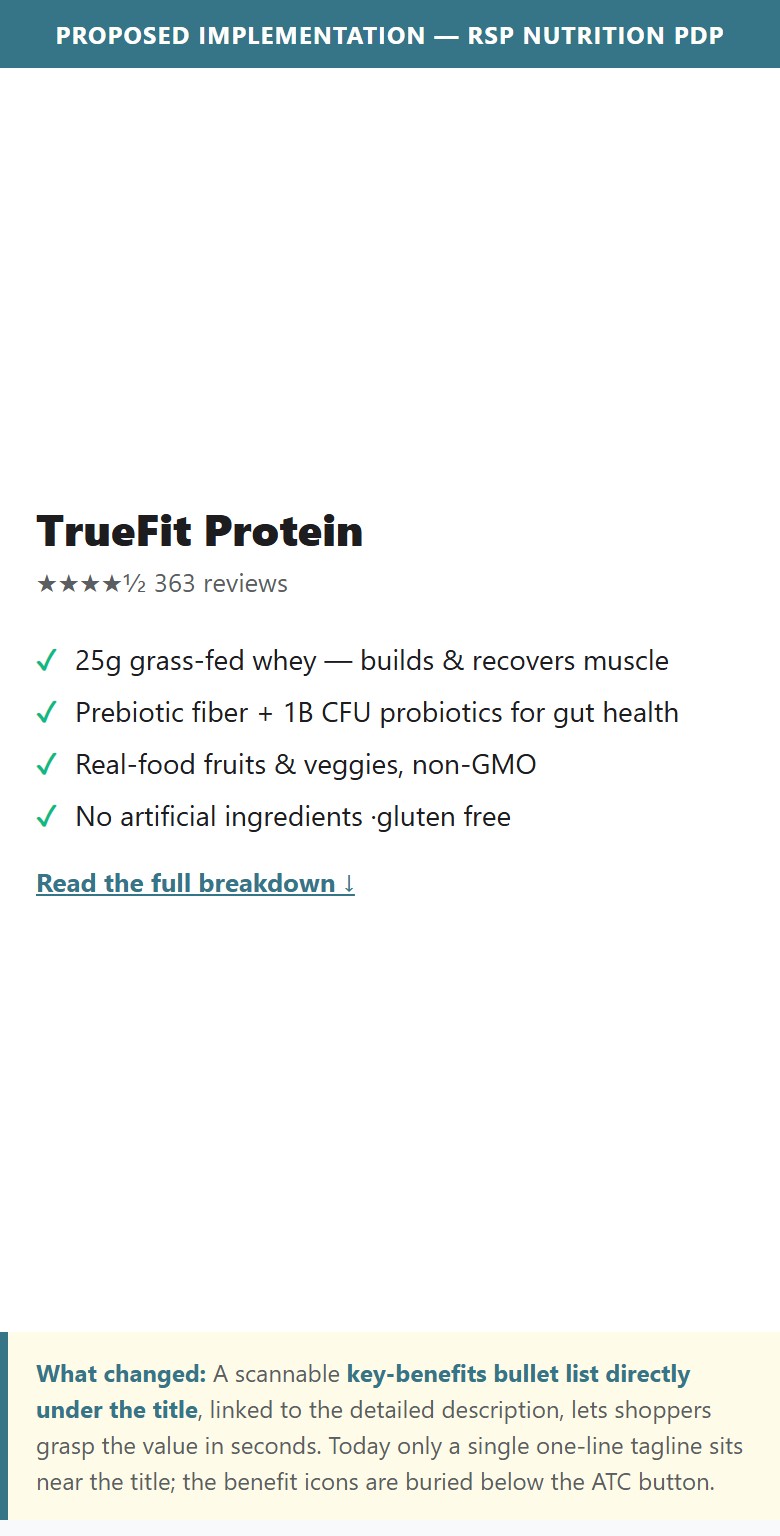
- Near the title, the PDP shows only a single tagline ('Protein, elevated - with fiber, probiotics, & superfoods built in.') — no scannable benefit bullet list (confirmed by live re-verification).
- The benefit icon grid (25g Grass-Fed Whey, Non-GMO Superfoods, Prebiotic Fiber & Probiotics, etc.) sits in a separate 'Complete Nutrition Without Compromise' section below the ATC — most shoppers decide before scrolling that far.
- Above-the-fold benefit bullets are how shoppers quickly answer 'what's in it for me?'; without them the value proposition is split between a vague tagline and an icon block the shopper may never see.
- Linking the bullets to the detailed description ('read the full breakdown') gives skimmers the gist and researchers a path deeper — a Standard high-converting PDP layout.
- Add 4-5 benefit bullets immediately under the title (25g grass-fed whey, prebiotic fiber + probiotics, real-food fruits & veggies, no artificial ingredients), each one line, with a 'Read the full breakdown' link to the description.
- Pull the existing benefit-icon content up to this position so the value proposition lives in the buy zone, not below the fold.
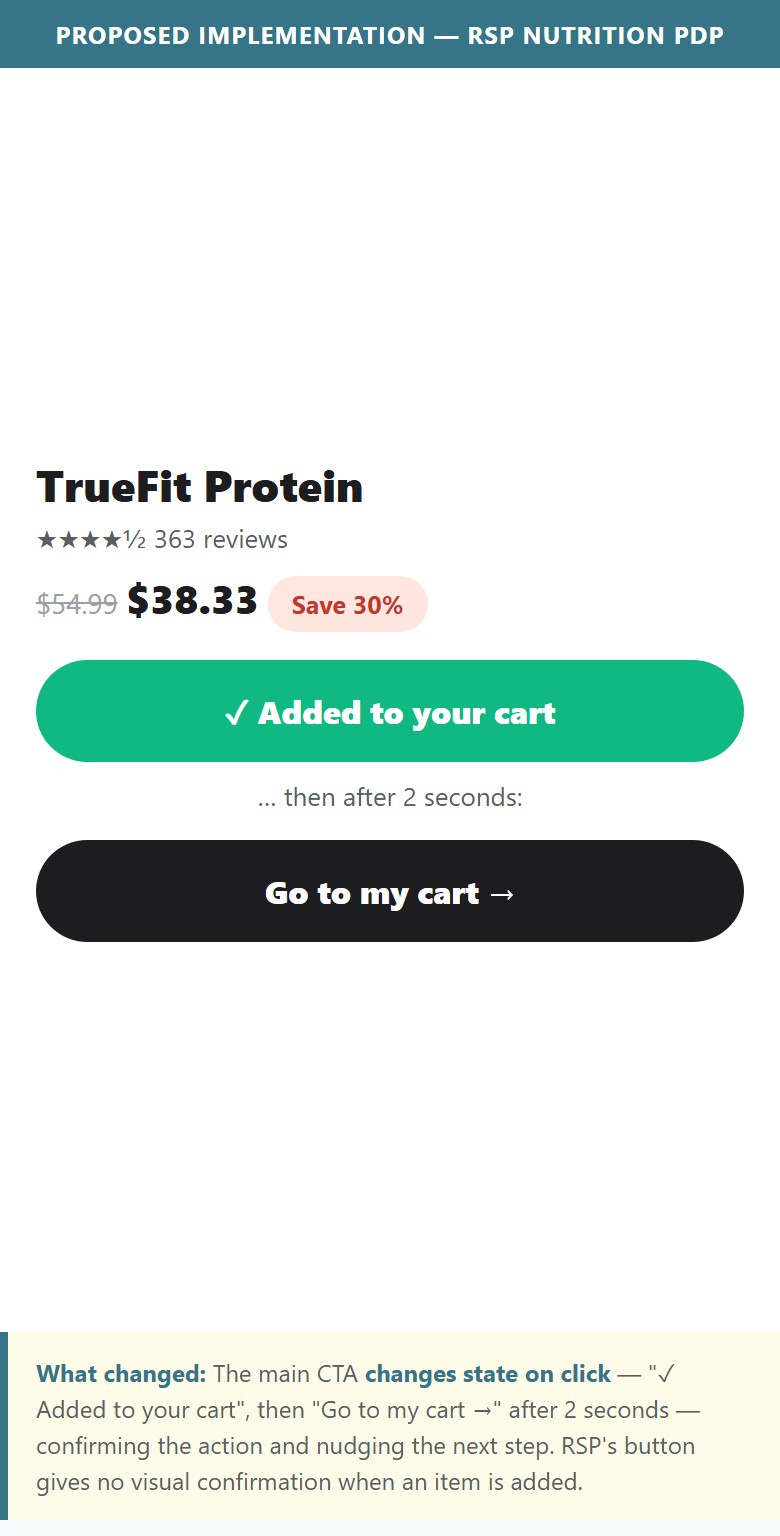
- Clicking ADD TO CART opens the cart drawer but the button itself does not change state — there is no '✓ Added' confirmation label or follow-on 'Go to cart' state (confirmed by live re-verification).
- A button that looks identical before and after a tap creates micro-uncertainty ('did that register?'), occasionally prompting duplicate taps or hesitation.
- A two-stage confirmation ('✓ Added to your cart' → after ~2s → 'Go to my cart →') closes the feedback loop and gives a clear, low-pressure path to checkout.
- This is a small, theme-level interaction change with outsized clarity benefit on mobile, where the drawer can be missed.
- On add-to-cart success, switch the button to a confirmation state ('✓ Added to your cart'), then after ~2 seconds to 'Go to my cart →' linking to the cart.
- Keep the cart-drawer behavior, but use the button state as the primary, always-visible confirmation so the action is unmistakable.
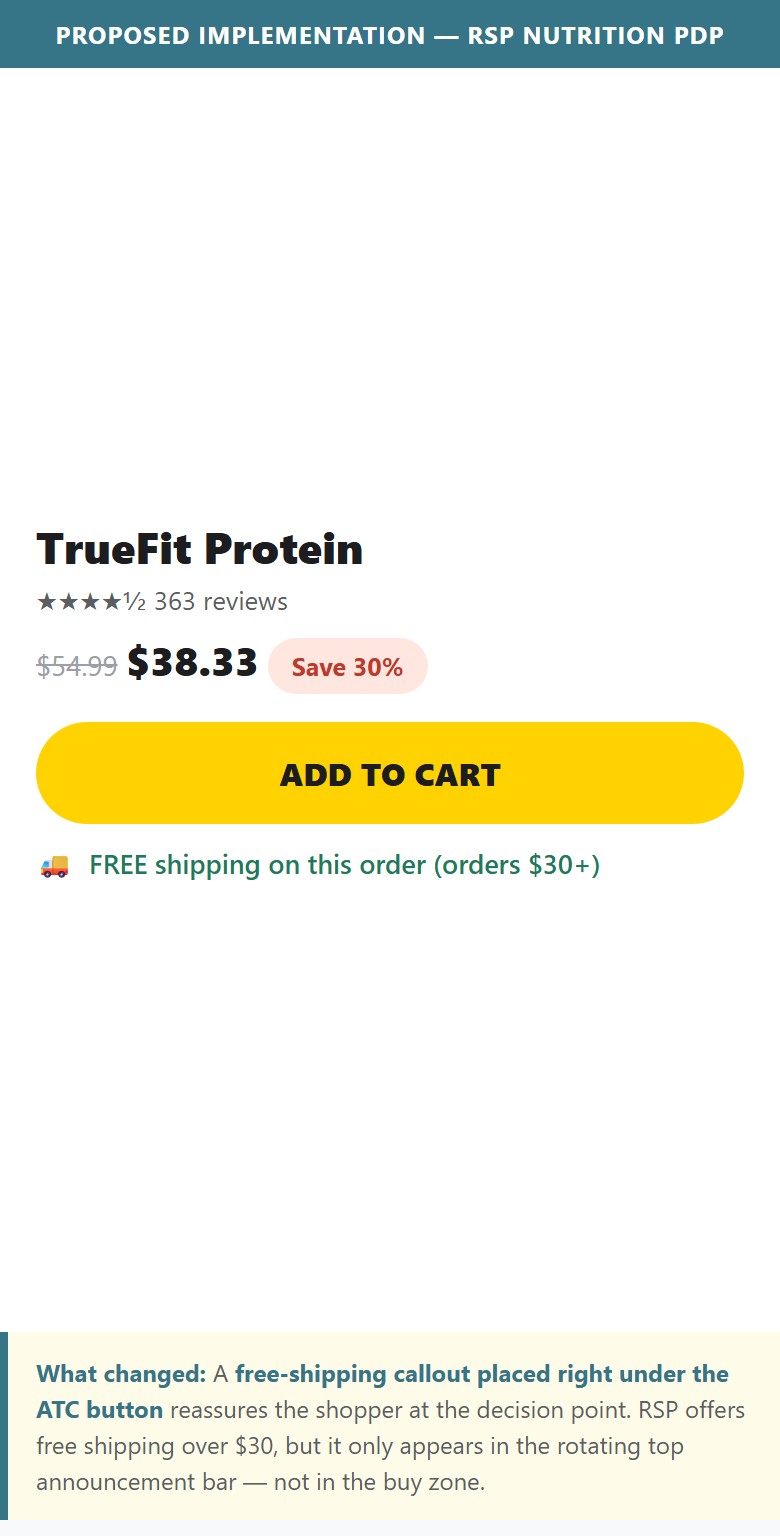
- Free shipping ('FREE SHIPPING ON ORDERS $30+') appears only in the rotating announcement bar at the very top of the page — there is no free-shipping message in the ATC zone (confirmed by live re-verification).
- Shipping cost is a top cart-abandonment driver; surfacing 'free shipping on this order' next to the buy button removes that doubt before it forms.
- At TrueFit's ~$38-$55 price points every order clears the $30 threshold, so the message is always true and always reassuring — it just isn't shown where it matters.
- Reinforcing free shipping in the buy zone is a Standard high-converting PDP pattern and competitors place it directly under the ATC.
- Add a single 'Free shipping on this order (orders $30+)' line with a truck icon directly below the ADD TO CART button.
- Keep the announcement-bar message, but treat the buy-zone callout as the primary reassurance so it's visible at the decision point.
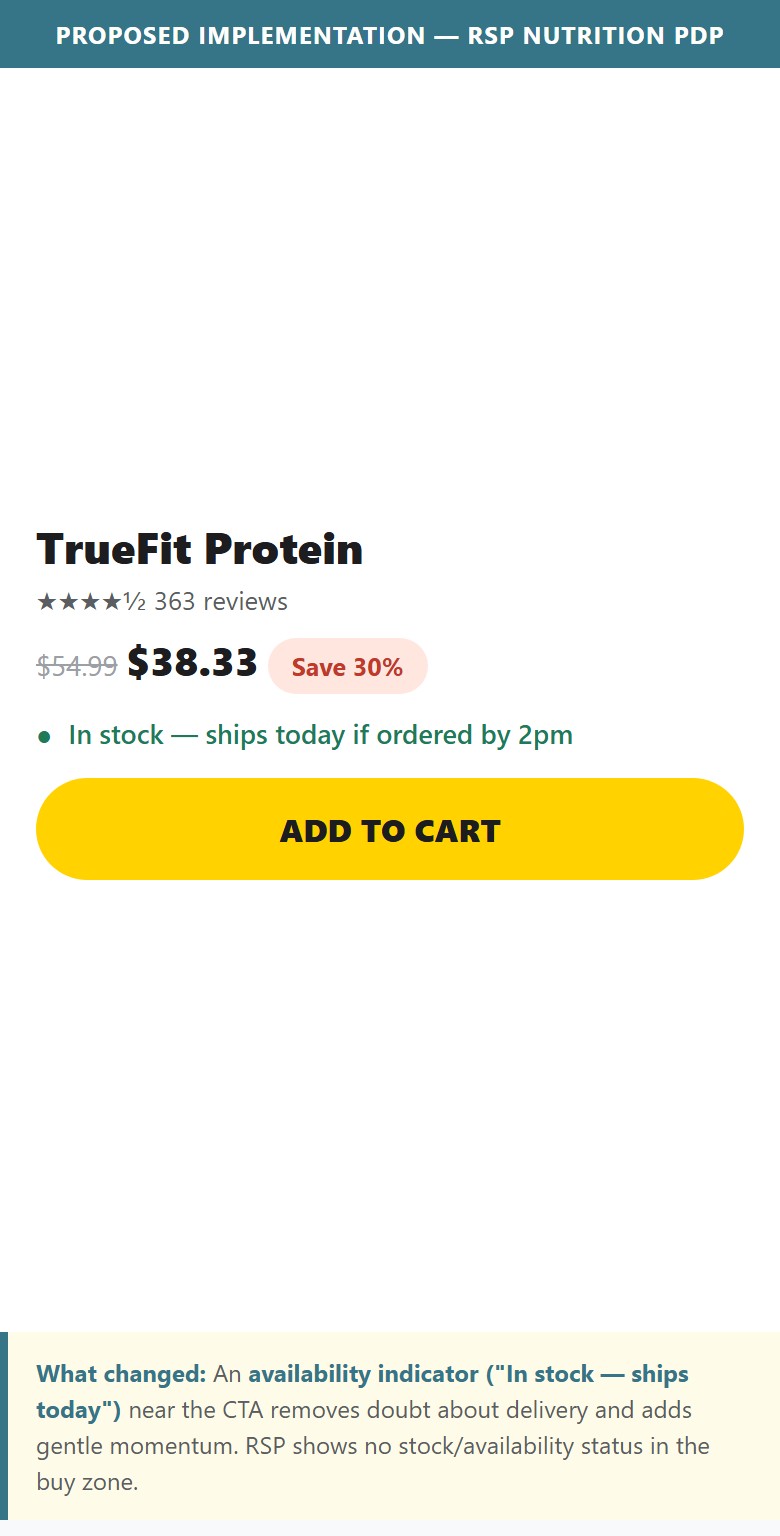
- There is no 'In stock', stock-status, or dispatch-time indicator anywhere near the ADD TO CART button (confirmed by live re-verification).
- An explicit availability signal answers an unspoken question ('can I get this now?') and, paired with a dispatch cutoff, adds a light, honest nudge to act.
- Stock/availability cues in the buy zone are a Standard reassurance on high-converting PDPs, especially for repeat-purchase consumables.
- Shopify exposes inventory state natively, so an 'In stock' badge is a theme-level addition.
- Show an 'In stock' status (green dot + label) near the ATC, optionally with a same-day-dispatch cutoff ('ships today if ordered by 2pm').
- Drive the indicator off Shopify's live inventory so it stays accurate and can switch to 'Low stock' / 'Back-in-stock' states automatically.
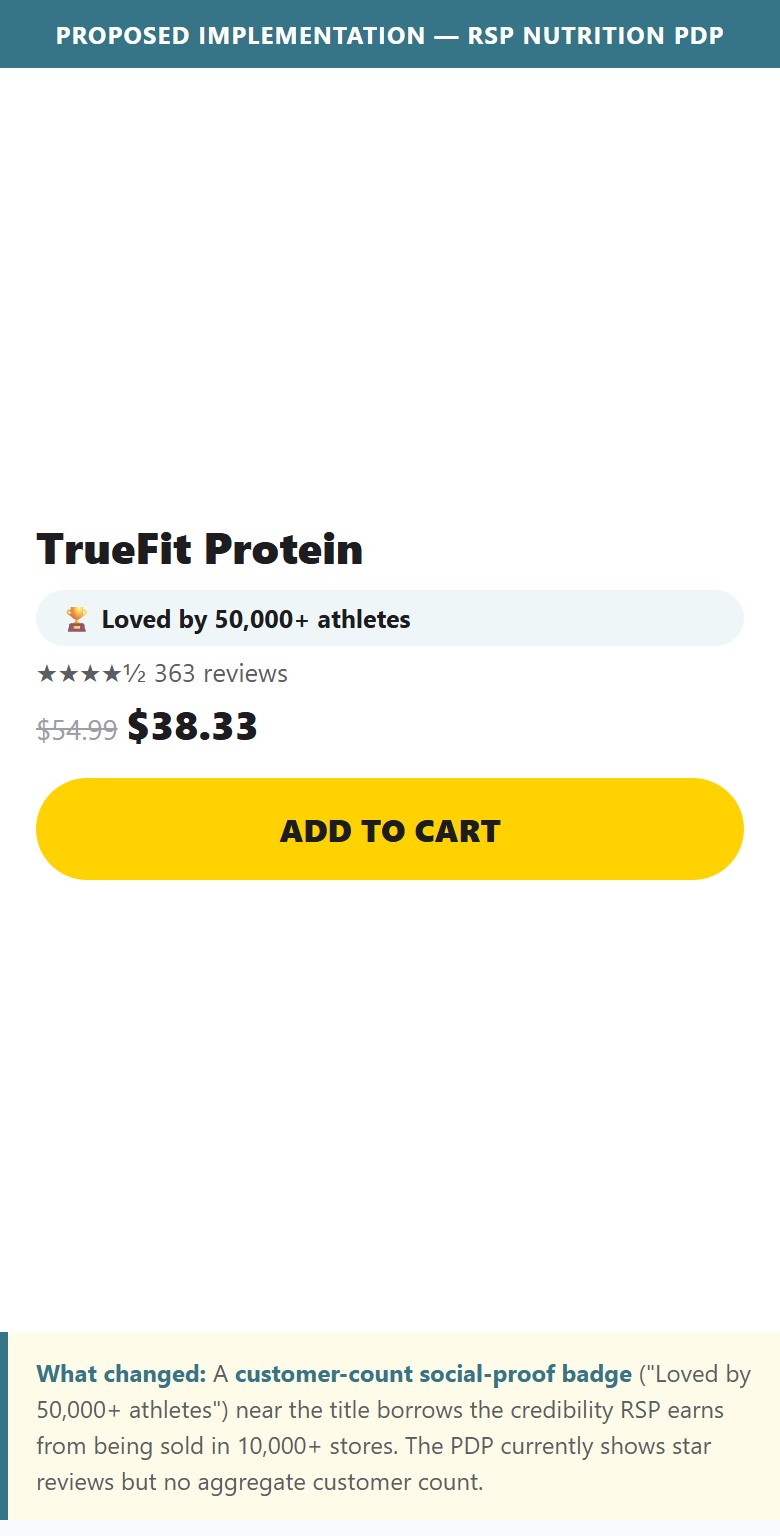
- The PDP shows a star rating and review count (363 reviews) but no aggregate customer-base figure such as 'X customers' or 'X sold' (confirmed by live re-verification).
- A large customer count is a fast, powerful trust signal — it reframes the purchase as 'joining many' rather than 'taking a risk', which is especially persuasive for first-time supplement buyers.
- RSP has strong real proof to draw on (sold in 10,000+ retail stores incl. Walmart, Target, Whole Foods) that is not surfaced on the PDP.
- Competitors lean on this pattern (e.g., 'Trusted by 55,000+ athletes') as a headline trust cue near the title.
- Add a customer-count badge near the title or ATC ('Loved by 50,000+ athletes' or a verified 'X sold' figure) — use a real, defensible number.
- Pair it with the existing retail-distribution proof ('Found in 10,000+ stores') to compound the credibility.
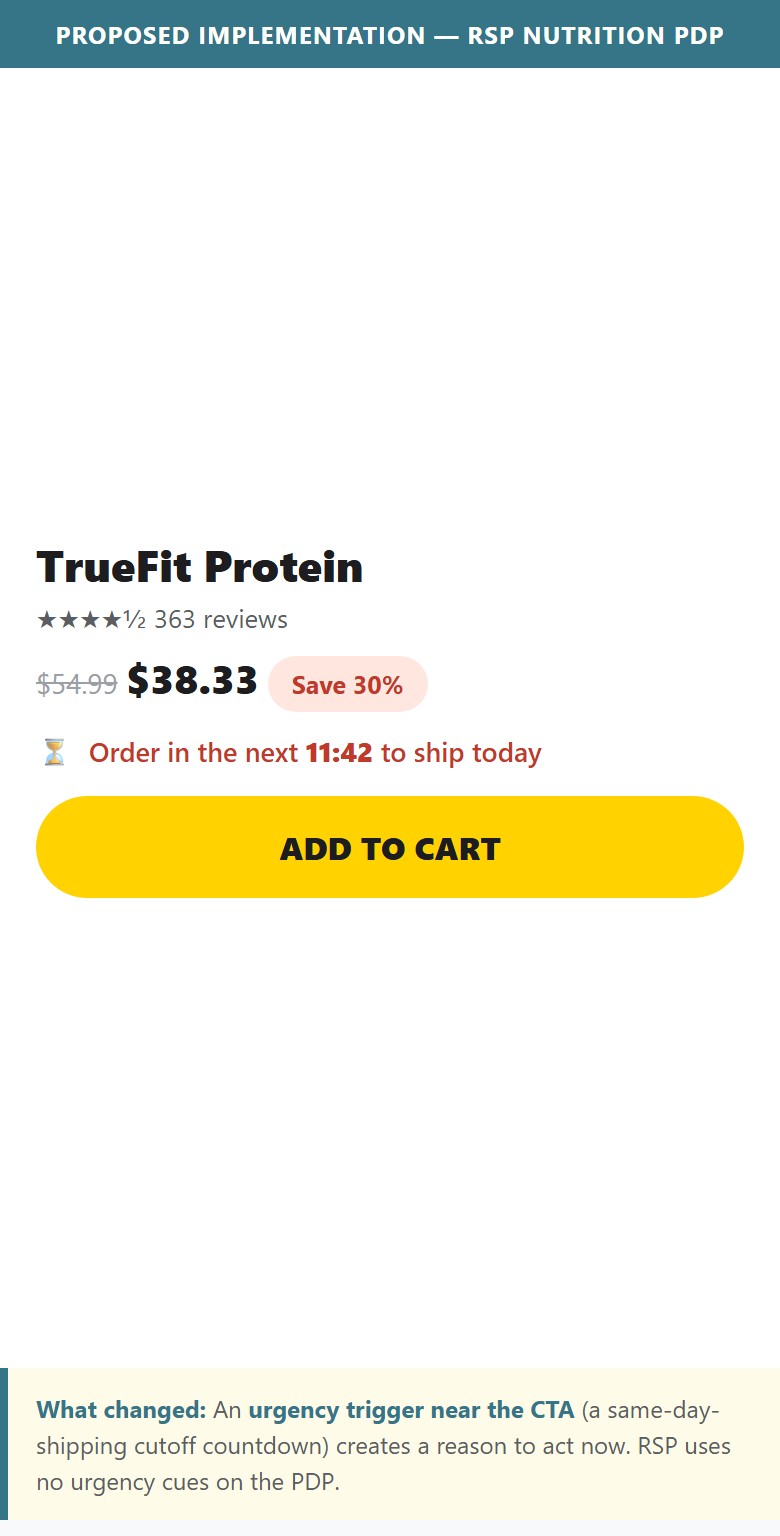
- The PDP uses no urgency triggers near the CTA — no same-day-shipping countdown, time-boxed offer, or 'order in X min' messaging (confirmed by live re-verification).
- Genuine urgency (a real dispatch cutoff, a real promo window) converts 'I'll think about it' into 'I'll do it now' without resorting to fake timers.
- RSP already runs a 30%-off-first-order Subscribe & Save offer that could be framed with light, honest urgency at the decision point.
- Used sparingly and truthfully, an urgency cue near the CTA is a Standard conversion lever on high-performing supplement PDPs.
- Add a real same-day-shipping cutoff near the ATC ('Order in the next 11:42 to ship today') driven by the actual fulfilment cutoff.
- Optionally frame the existing first-order discount with honest time/scope ('30% off your first order') — avoid fabricated countdowns.
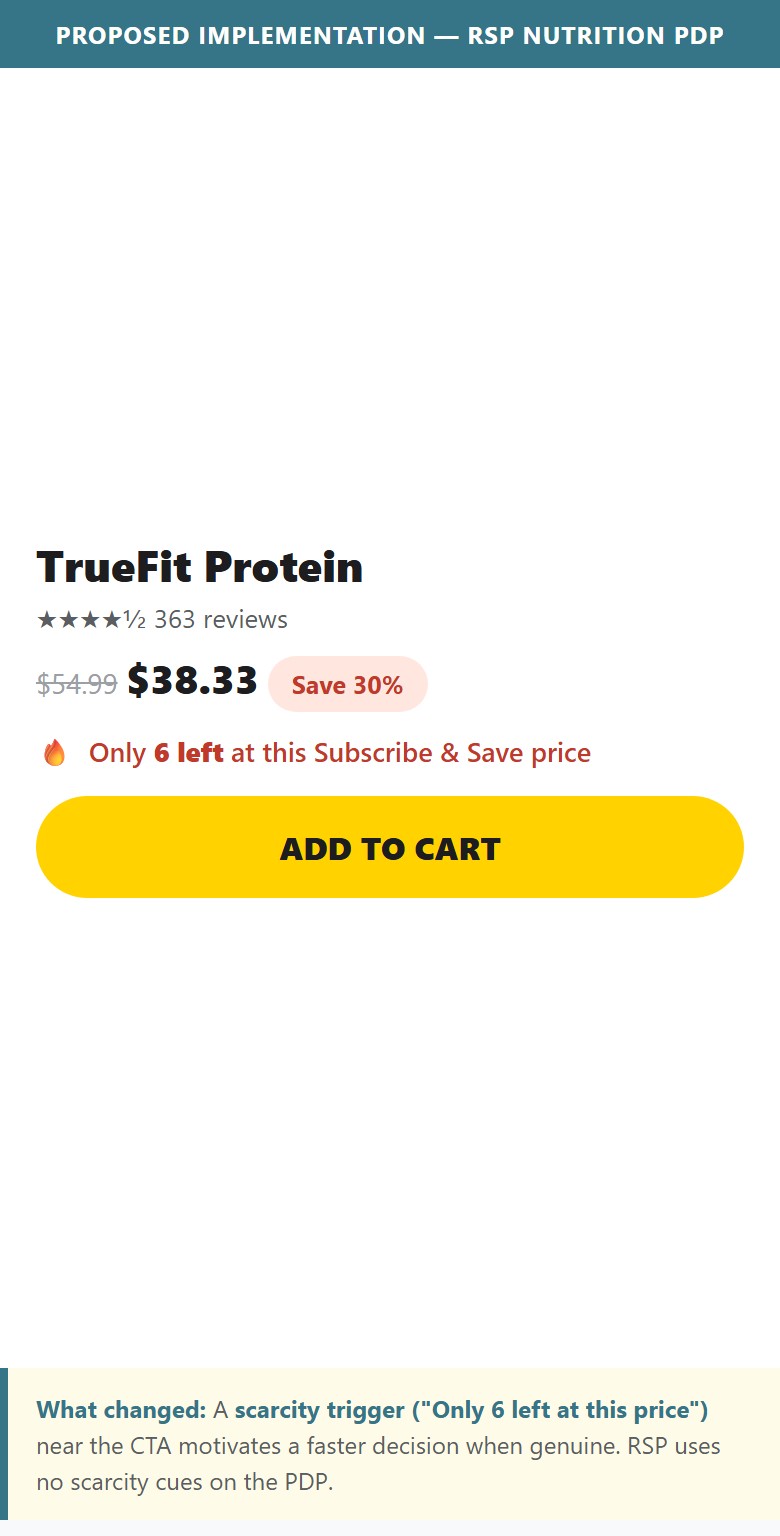
- No scarcity messaging ('Only X left', 'Low stock') appears anywhere near the CTA (confirmed by live re-verification).
- When genuine, a low-stock indicator is a powerful, honest nudge — it signals demand and a real cost to waiting.
- Scarcity must be truthful to protect trust; driven off live inventory it stays accurate and only shows when stock is actually low.
- Low-stock cues near the CTA are a Standard conversion pattern that RSP currently leaves on the table.
- Show a live-inventory low-stock cue near the ATC ('Only 6 left') that appears only below a real threshold — never a fabricated number.
- Consider scoping scarcity to limited promo allocations (e.g., 'limited units at the 30%-off price') where that is genuinely true.
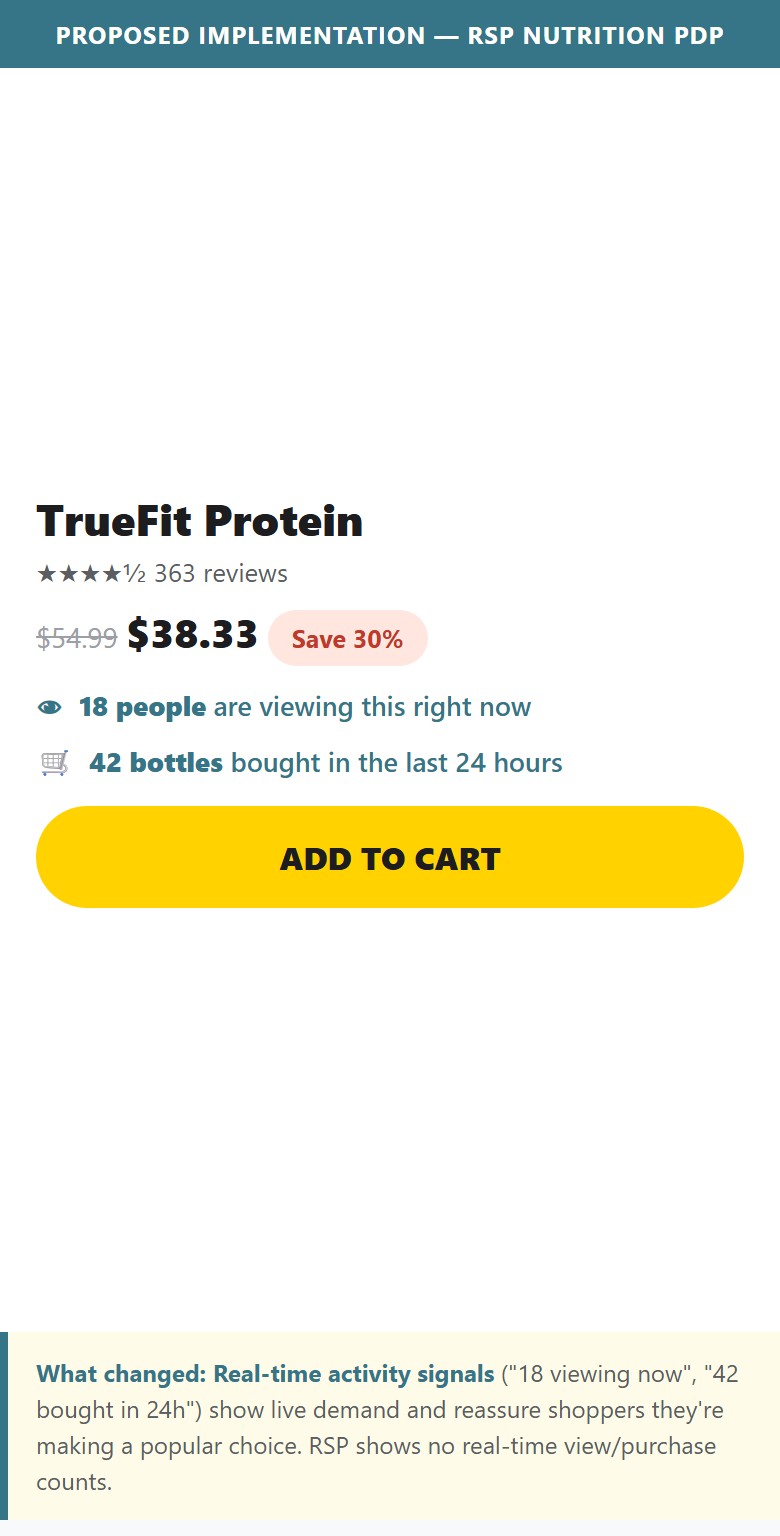
- The PDP shows no real-time activity signals — no 'X people viewing', 'X bought in the last 24h', or similar live-demand cue (confirmed by live re-verification).
- Real-time social proof is a dynamic complement to static review counts: it shows the product is actively chosen right now, which is reassuring at the moment of decision.
- For a popular SKU like TrueFit Protein (363 reviews, bestseller), genuine live counts would frequently be impressive and on-brand.
- These cues are delivered by lightweight social-proof apps that read real store events, keeping them honest.
- Add real-time view/purchase counters near the ATC (e.g., Fomo, Nudgify, or a Rebuy widget) driven by genuine store activity — not fabricated numbers.
- Start on best-sellers where the live numbers are strong, then roll out catalog-wide.
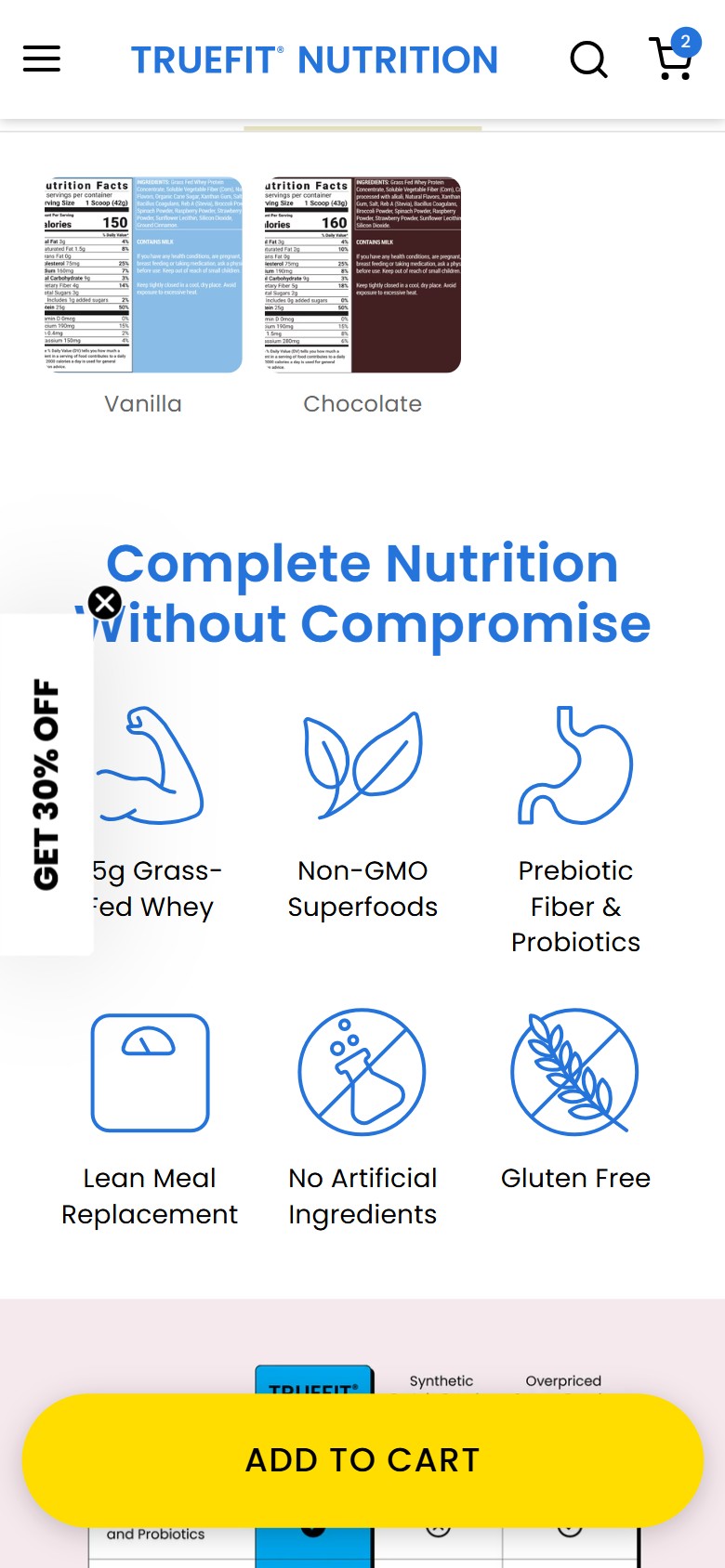
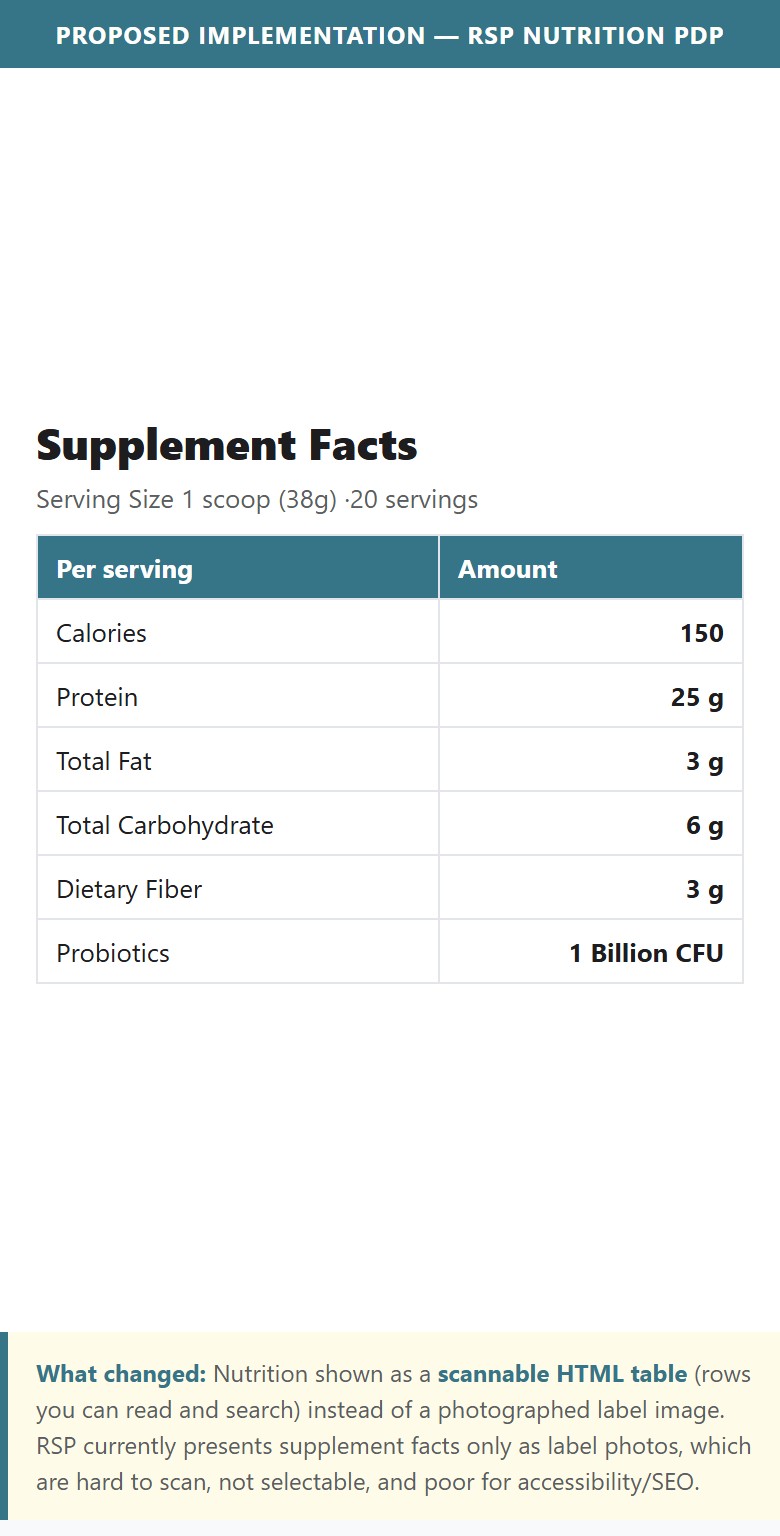
- The 'Nutrition' accordion opens to images of the supplement-facts label (one per flavor) — there is no real HTML table of values (confirmed by live re-verification).
- A photographed label is hard to scan on mobile, can't be selected or searched, doesn't reflow, and is invisible to search engines and screen readers.
- Supplement buyers actively compare specific values (protein per serving, sugar, fiber, calories); a structured table lets them find a number in seconds instead of pinch-zooming an image.
- An HTML nutrition/ingredients table is the Standard, scannable presentation on high-performing supplement PDPs and improves the page's overall information structure.
- Render supplement facts as a structured HTML table (Per serving / Amount rows: Calories, Protein, Fat, Carbs, Fiber, Probiotics, etc.) instead of a label photo.
- Keep the label image as a secondary reference, but make the table the primary, scannable source — improving mobile readability, accessibility, and SEO.
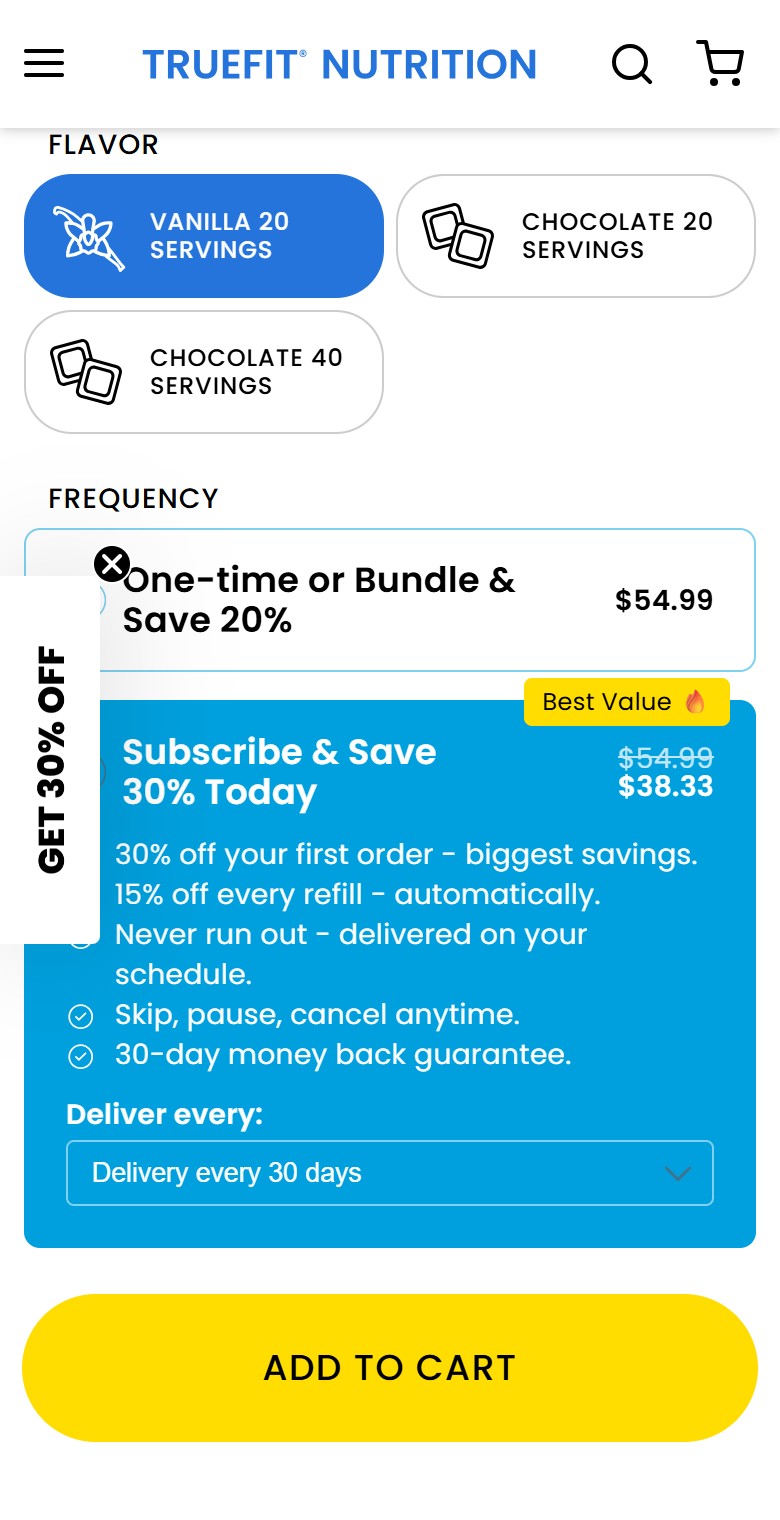
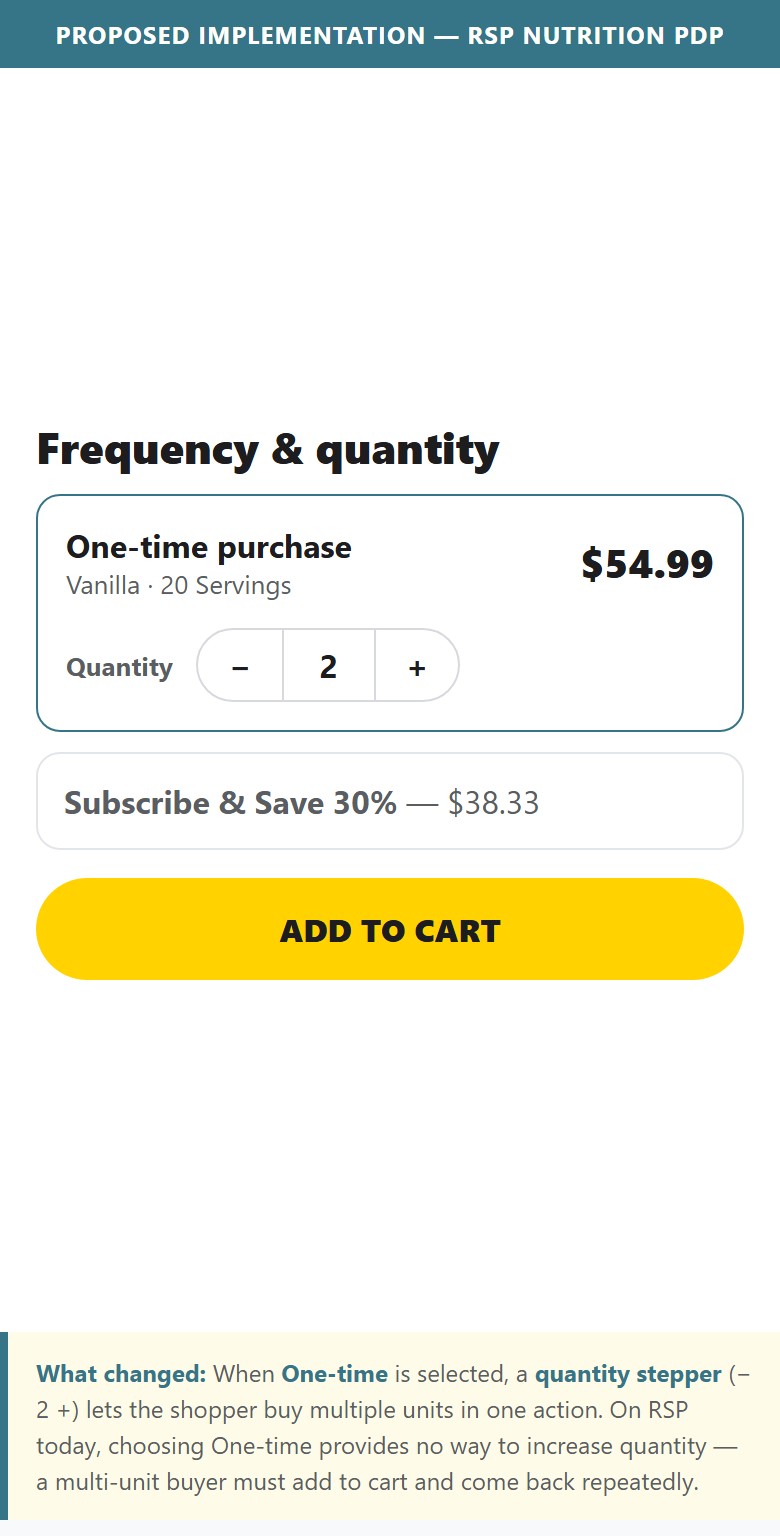
- On the TrueFit Protein PDP, selecting the 'One-time or Bundle & Save' frequency shows no quantity stepper — there is no way to buy more than a single unit of that flavor in one action (confirmed by live re-verification).
- Supplement buyers frequently stock up (2-3 tubs at once) or buy one-time for a household; without a quantity control they must add to cart, return to the PDP, and add again — friction that suppresses multi-unit orders and AOV.
- The Subscribe & Save path manages recurring quantity, but the one-time path — used by gift buyers, first-time triers, and non-subscribers — has no quantity affordance at all.
- A quantity selector on the one-time option is a standard PDP control; its absence is an easy AOV lever to recover.
- Add a quantity stepper (− / value / +) to the One-time purchase option so shoppers can set 2+ units before adding to cart.
- Keep the Subscribe & Save flow as-is; the quantity control only needs to appear for the one-time/bundle path.
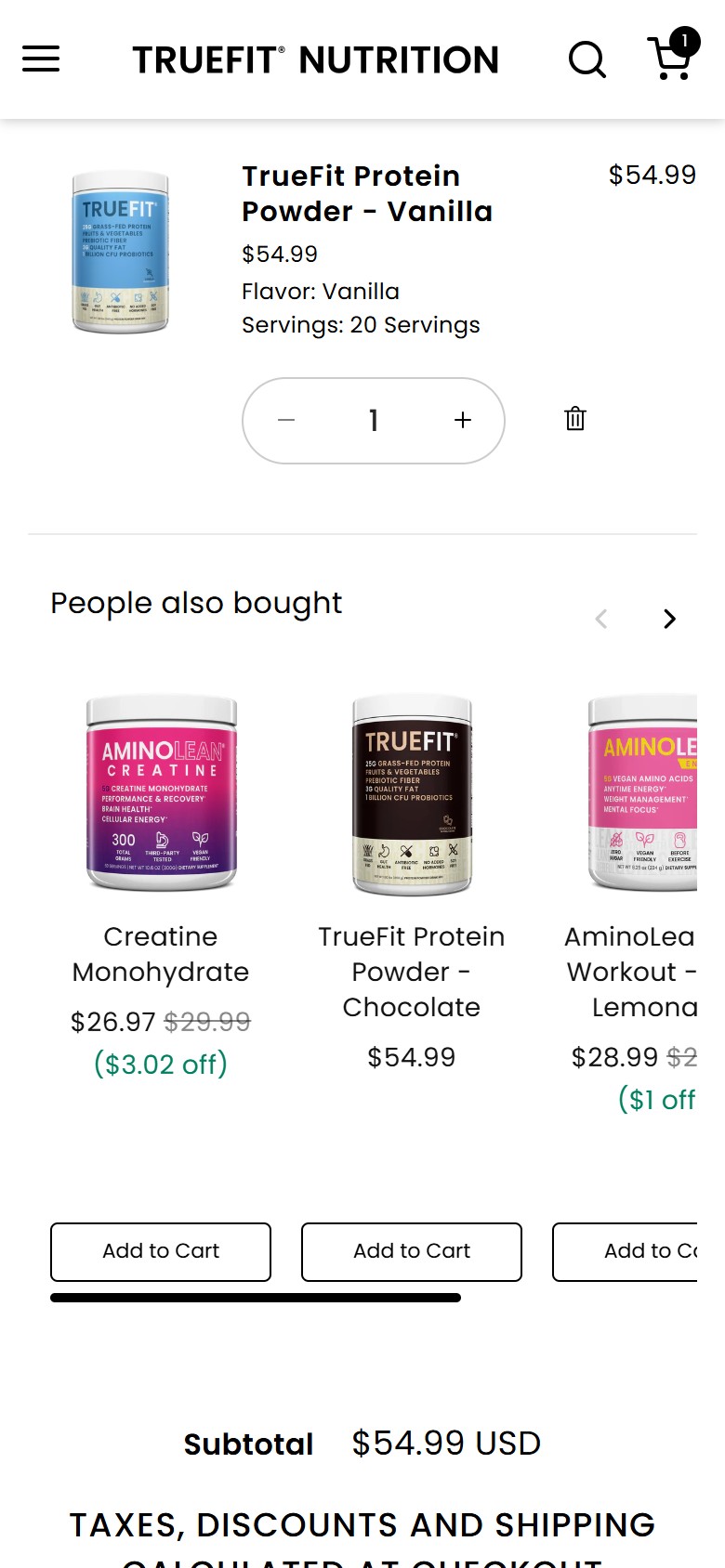
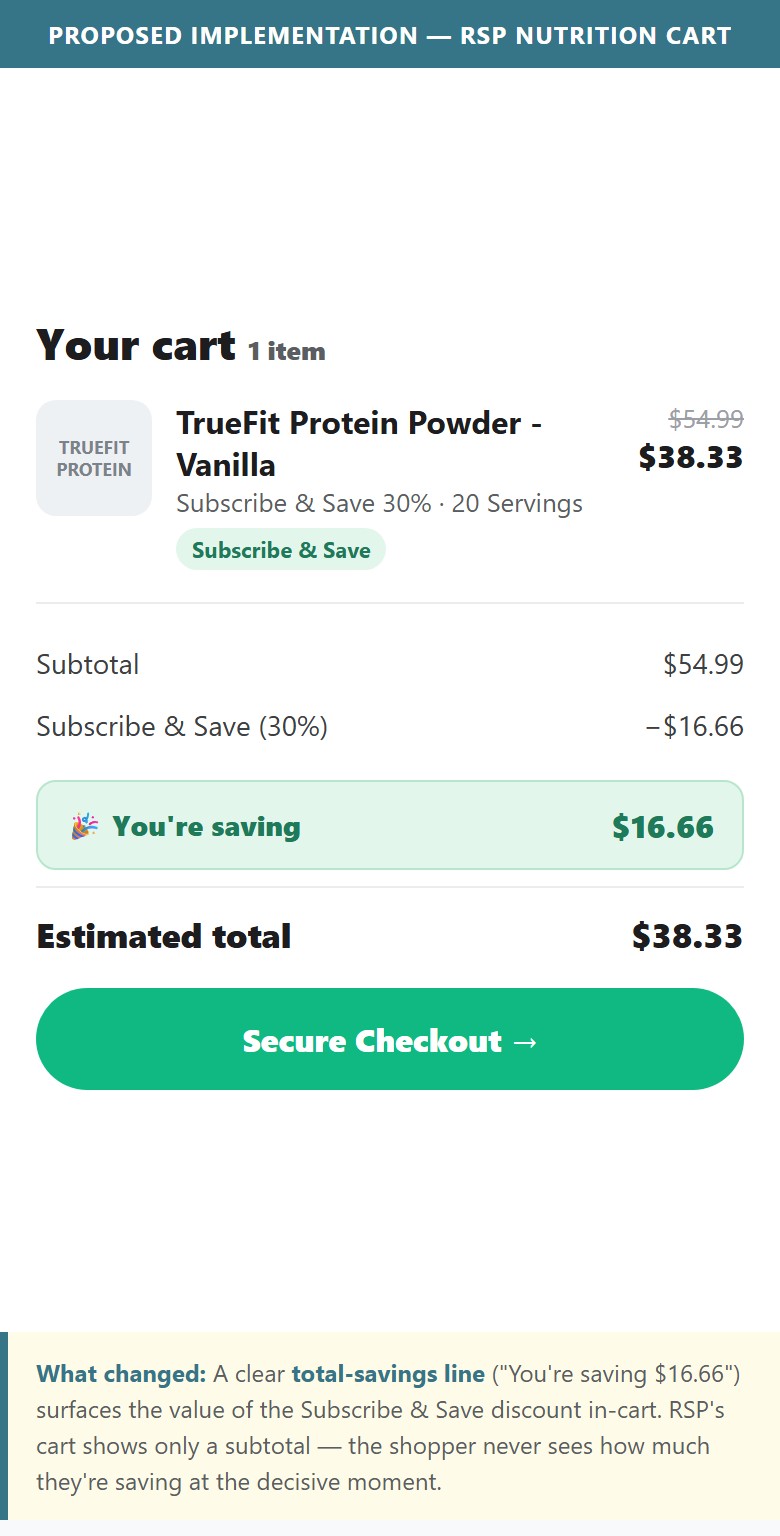
- The TrueFit Protein cart shows a single line — Subtotal $54.99 USD — with no aggregate "total savings" figure anywhere in the order summary (confirmed by probe CART-11 and live re-verification).
- RSP runs Subscribe & Save (30% off, bringing a $54.99 tub to $38.33 — a $16.66 saving) plus bundle discounts, so active carts frequently contain real dollar savings — yet the total saved is never stated, only the discounted line price.
- Subscribers often forget the magnitude of their discount between the PDP toggle and the cart; surfacing "You're saving $16.66 with Subscribe & Save" reminds them of the deal they accepted and reduces toggle-off.
- A total-savings line reinforces the promotional framing established on the PDP and is a low-effort, high-visibility reassurance right before the checkout tap.
- Add a 'You save: $X.XX' line to the cart summary by totalling the difference between compare-at and selling prices across all line items — a native Liquid calculation in Shopify cart templates.
- Style the savings line in a success tone (green) to differentiate it from neutral price rows and create a positive emotional signal before CHECK OUT.
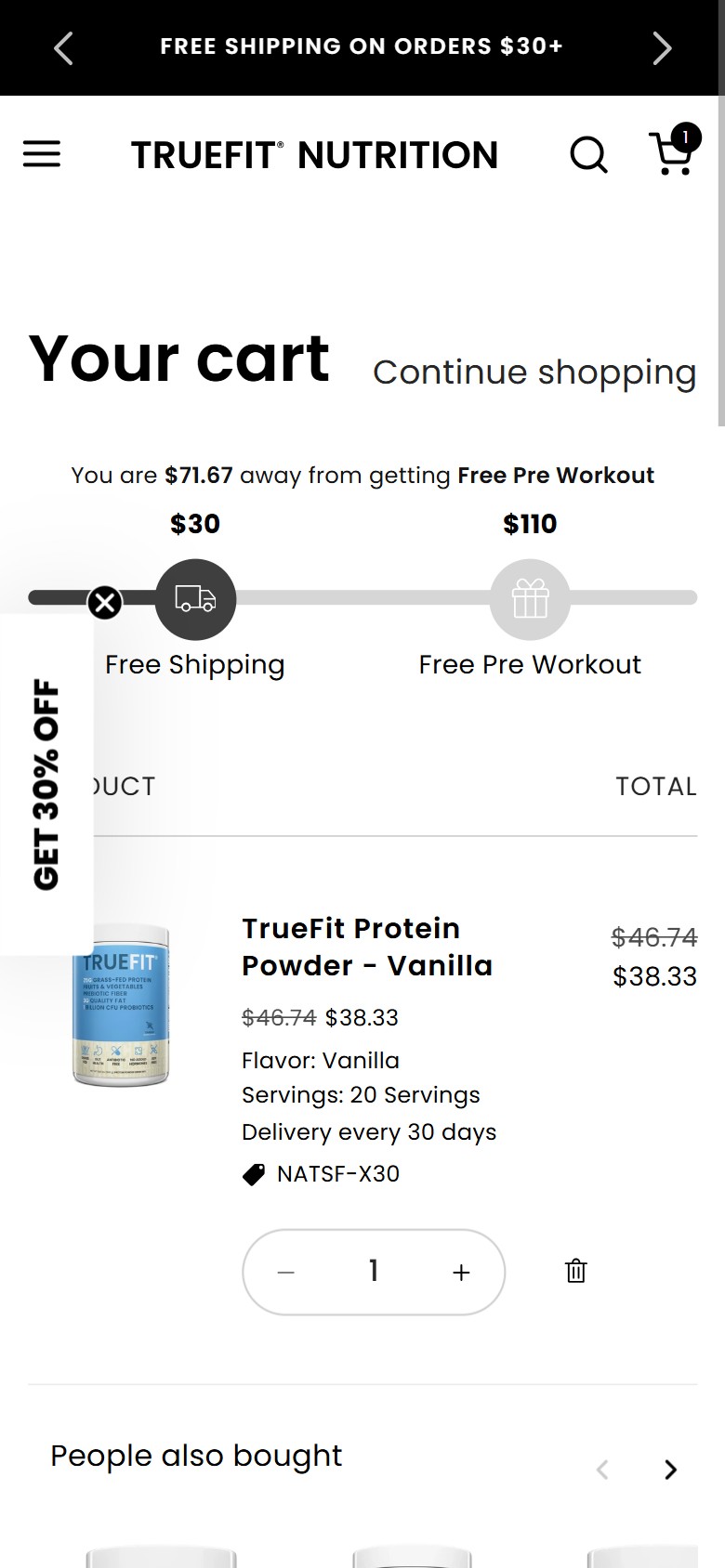
- RSP's cart has no coupon or promo-code input — the only acknowledgment of discounts is a footer note, 'TAXES, DISCOUNTS AND SHIPPING CALCULATED AT CHECKOUT' (confirmed by probe CART-08 and live re-verification with a TrueFit Protein in cart).
- RSP runs an email capture offering '30% off your first order' — new subscribers reasonably expect to apply that code at the cart step, not discover the field only at checkout, creating a moment of doubt.
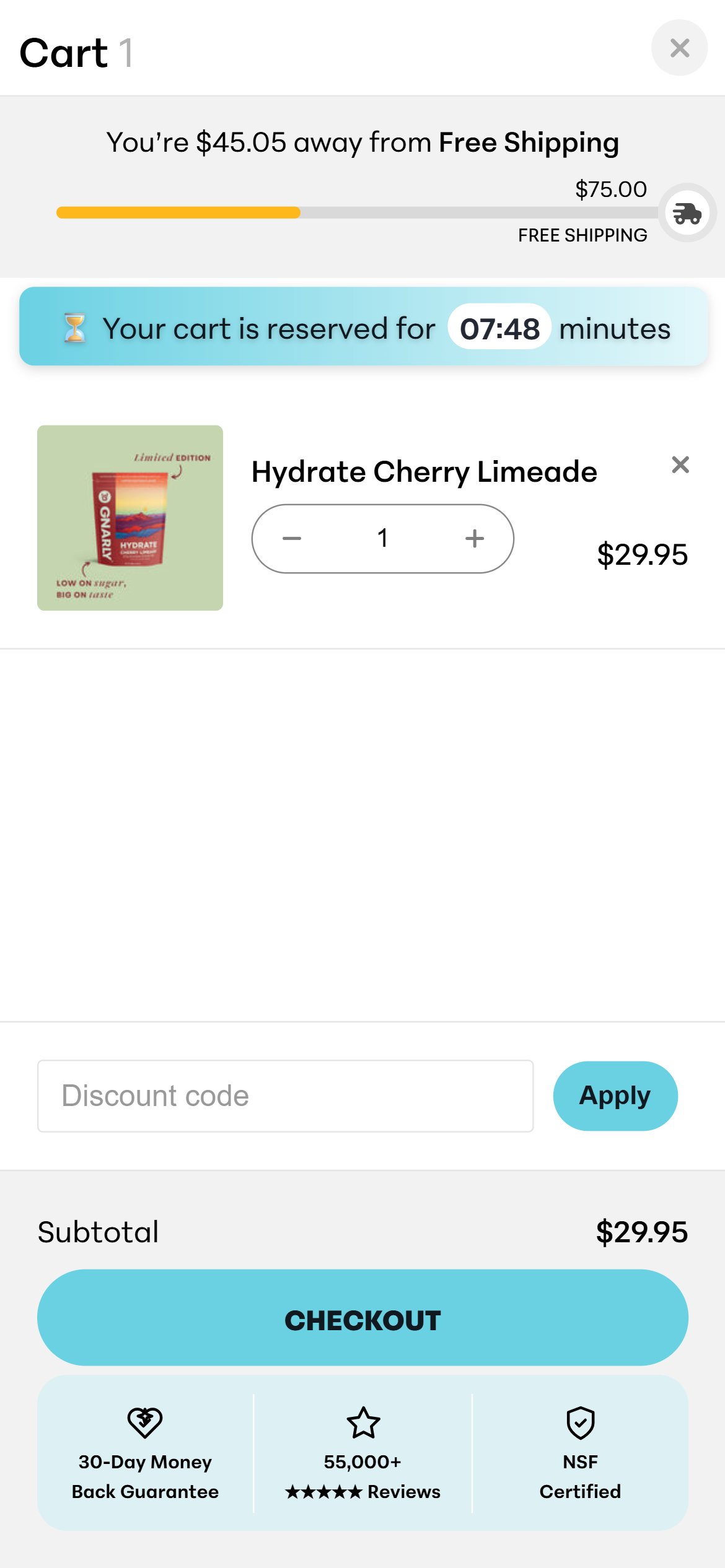
- Gnarly Nutrition shows a 'Discount code' input with an Apply button directly in the cart, so shoppers can confirm their code works before committing to checkout.
- A collapsed 'Have a promo code?' link (rather than an open field) provides clear affordance for those who have a code without prompting code-hunting from those who don't.
- Add a collapsed 'Have a promo code?' toggle above CHECK OUT that expands to a text input + Apply button; keep it collapsed by default to avoid prompting coupon-hunting.
- Alternatively, auto-apply discounts via URL parameter (`?discount=CODE`) in all Klaviyo / Justuno / Postscript campaign links so subscribers never need to enter the code manually — Shopify-native, no development.
App Ecosystem
What's installed vs what's missing from best-in-class Health & Wellness stores
Present (4)
Missing (5)
App Stack Assessment
RSP Nutrition's app ecosystem is well-configured for acquisition and first-purchase conversion: the reviews app delivers strong social proof with photo UGC, the subscription app supports recurring revenue with a 30% first-order incentive, the email capture app drives list growth, and the cart optimization app adds upsell and reward-bar logic. The gaps are in retention and discovery — no loyalty program, no product quiz for goal-based recommendation, and no post-purchase upsell layer — all of which are high-ROI additions for a brand with RSP's SKU breadth and supplement repeat-purchase dynamics.
Confidential — Prepared for RSP Nutrition by Growisto | June 2026